bright_siren
The Hubble constant from an event with an identified host galaxy (bright siren), alone or combined with the spectral siren. It takes seconds: no sampling.
gwtc_analysis bright_siren                                            # GW170817 and NGC 4993
gwtc_analysis bright_siren --spectral-posterior hubble_constant_run   # combined with the spectral siren
gwtc_analysis bright_siren --src-name GW190521                        # candidate AGN flare, z = 0.438
Method
The GW signal gives the luminosity distance \(d_L\) with no distance ladder; the host gives the Hubble-flow redshift \(z\). For a nearby galaxy, \(z\) comes from its recession velocity minus its peculiar velocity, \(c z = v_r - \langle v_p \rangle\). In flat ΛCDM, with \(\Omega_m = 0.3065\) as in the spectral siren,
For sources uniform in comoving volume and source-frame time, \(p_\text{pop}(z) \propto \frac{dV_c}{dz} \frac{1}{1+z}\), and with a flat H₀ prior (Chen, Fishbach & Holz 2018 [72]; Mandel, Farr & Gair 2019 [35]):
\(\mathcal{L}_\text{GW}\) is the posterior of \(d_L\) divided by the PE distance prior, read from the file (\(d_L^2\) up to O3, uniform in comoving volume in O4). Over the PE samples \(d_i\), whose redshift at a trial H₀ is \(z_i\), the integral is a kernel sum:
where \(h\) is the kernel width of the \(z_i\) (Silverman's rule). It only matters for a distant host with a spectroscopic redshift, much narrower than the spread of the samples.
The selection term \(\beta(H_0)\) is the fraction of the population that would be detected. At a
given redshift a larger H₀ means a smaller distance, so a louder signal. Leaving β out biases H₀:
see Validation. --selection:
| Value | β(H₀) | Use |
|---|---|---|
euclidean |
∝ H₀³: GW-limited detection of nearby sources. It cancels the volume factor of the numerator, and with a \(d_L^2\) prior the posterior becomes \(\sum_i \mathcal{N}(v_H;\, H_0 d_i,\, \sigma_v)\), the LVK 2017 formula [27] | z < 0.05 |
injections |
the found LVK sensitivity injections of the event's observing run, carried to the source frame at each trial H₀ and reweighted to the population of the event's class: Power Law + Peak for black holes (as in rates), uniform 1–2.5 M☉ for neutron stars; the injected isotropic spins |
distant events |
auto (default) |
euclidean below z = 0.05, injections above |
Sky position. The distance must be the one at the counterpart's position: distance and sky
position are correlated through the antenna pattern. The GWTC-1 GW170817 samples were produced with
the sky fixed to AT2017gfo and are used as they are. Other samples are restricted to those within
--sky-radius of the counterpart.
Registered events
| Event | Host | z | Status | Selection (auto) |
|---|---|---|---|---|
| GW170817 | NGC 4993, AT2017gfo | 3017 ± 166 km/s (\(v_r\) 3327 ± 72, \(\langle v_p \rangle\) 310 ± 150) [27] | confirmed (kilonova) | euclidean |
| GW190521 | AGN J124942.3+344929, ZTF19abanrhr | 0.438 ± 0.0015 [74] | candidate | injections (O3a, BBH) |
GW190521 is a candidate. Graham et al. proposed the ZTF flare in an AGN disk as the counterpart [74]. The odds of a common source are only 1 to 12, depending on the waveform model (Ashton et al. 2021 [75]). Its result is H₀ if the flare is the counterpart, and the report says so.
A new event needs one entry in COUNTERPARTS (gwtc_analysis/bright_siren.py): the host, the
counterpart's position, the redshift or the velocities, the observing run, the population class, and
the PE file (pe_event, read from Zenodo).
Results
| Event, PE label | Maximum a posteriori, 68% interval | Median, 90% interval |
|---|---|---|
| GW170817, LowSpin | 69.8 (+23.6 / −8.2) | 79.9, 63.0–135.5 |
| GW170817, HighSpin | 69.4 (+14.8 / −7.4) | 74.8, 62.2–112.2 |
| GW170817, LVK 2017 [27] | 70.0 (+12.0 / −8.0) | |
| GW190521 + ZTF19abanrhr, IMRPhenomXPHM | 30.4 (+61.0 / −7.0) | 63.2, 26.1–129.5 |
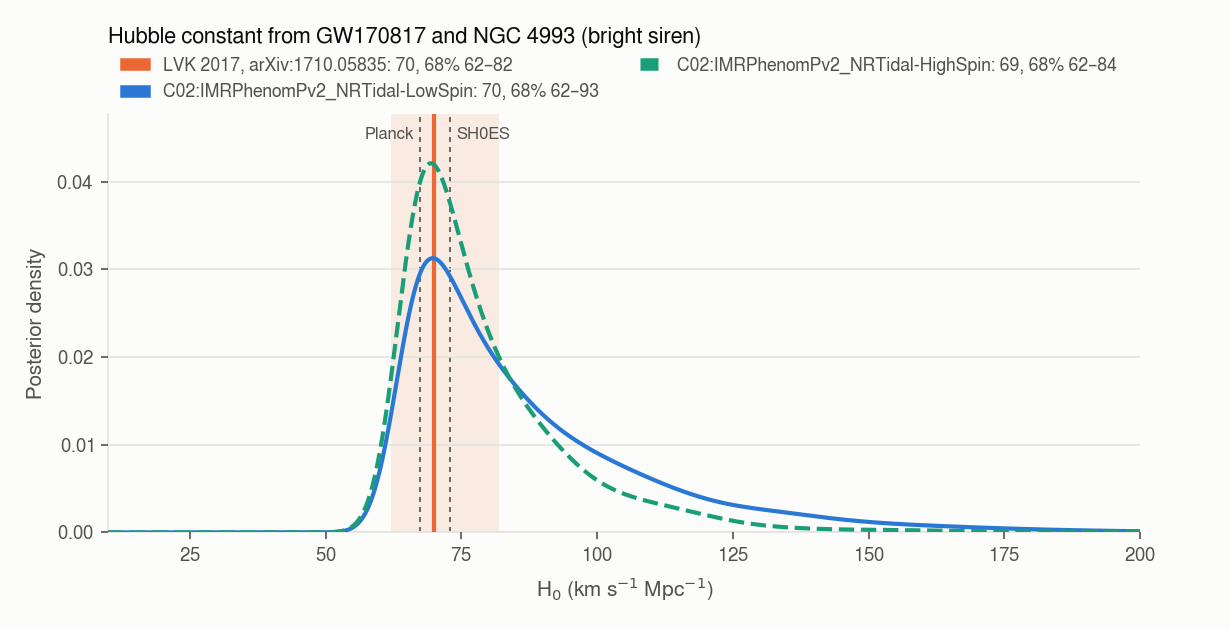
GW170817. The maximum a posteriori and the lower side agree with the published value. The upper side is wider because the public GWTC-1 samples come from a later reanalysis (GWTC-1, IMRPhenomPv2_NRTidal), whose distance has a longer low-distance tail than the 2017 analysis (43.8 +2.9 −6.9 Mpc). That tail comes from the distance–inclination degeneracy: an inclined binary is fainter than a face-on one at the same distance. Constraining the inclination with the radio jet narrows H₀ considerably (Hotokezaka et al. 2019 [73]); this mode does not use EM inclination constraints. The full ΛCDM \(d_L\) raises H₀ by 0.8% (0.6 km/s/Mpc) compared with the linear Hubble law of the 2017 paper.
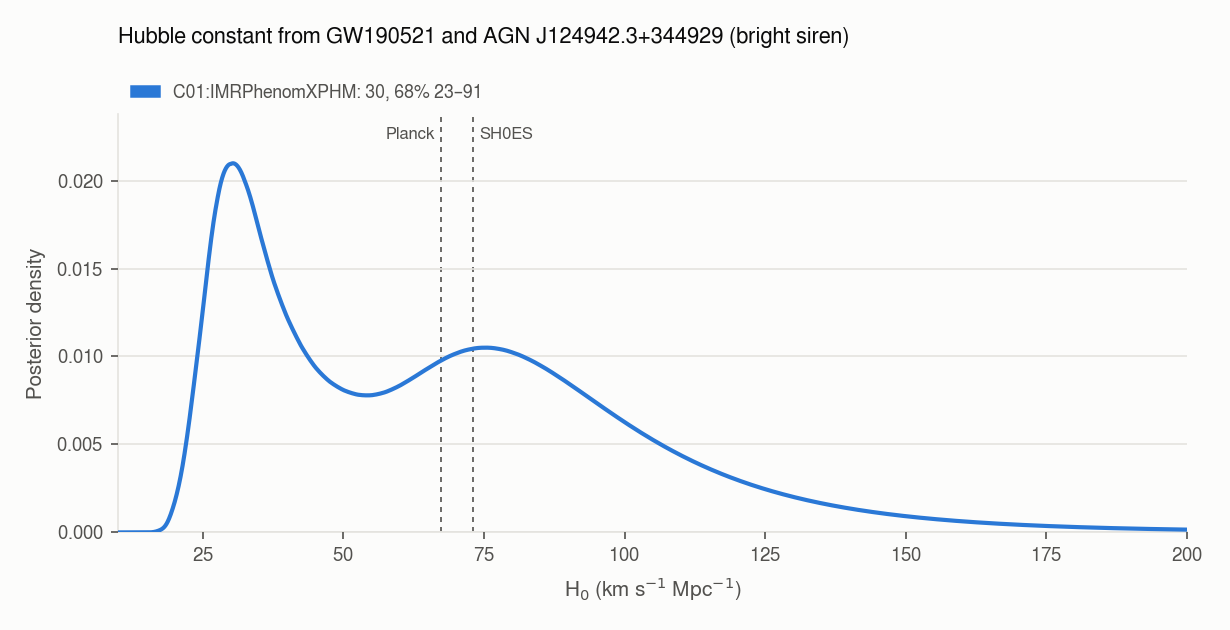
GW190521. The posterior is bimodal because the distance posterior is, in the direction of the flare. At z = 0.438, H₀ ≈ 30 corresponds to \(d_L\) ≈ 5.6 Gpc and H₀ ≈ 75 to 2.25 Gpc; the samples within 3° of the flare have a median of 4.6 Gpc with 16% below 2.2 Gpc. The result depends on the sky selection (median 54.7 within 5°, against 63.2 within 3°) and on the waveform model; only IMRPhenomXPHM has enough samples near the flare in GWTC-2.1. The selection term is computed from 106,376 found O3a injections, with 13,000–16,000 effective injections over the H₀ range.
Combination with the spectral siren
--spectral-posterior takes a hubble_constant work directory (its posterior_reweighted.tsv, else
posterior.tsv) or any TSV with an H0 column. The two measurements use different events (the
spectral siren uses binary black holes; leave the bright-siren event out of it) and the same flat
prior, so their posteriors multiply. The spectral-siren density is a Gaussian kernel estimate,
reflected at the prior bounds.
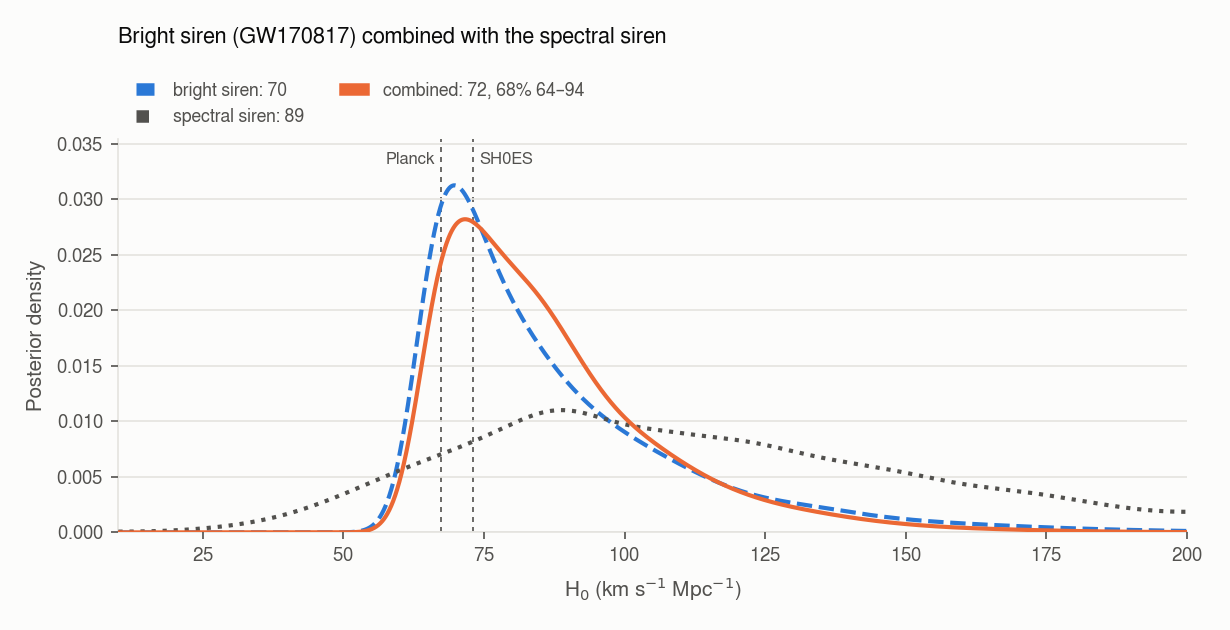
GW170817 with the Power Law + Peak spectral siren (GWTC-4.0 setup): H₀ = 71.7 (+22.3 / −8.0) km/s/Mpc (maximum a posteriori, 68%). GW170817 dominates; the broad spectral siren shifts the posterior slightly upwards.
Validation: mock bright sirens
The analysis is tested on simulated detections with a known H₀ (tests/test_bright_siren.py).
- Sources: uniform in comoving volume up to z = 4, masses uniform in 20–40 M☉, random orientations.
- Detection: each source has a network SNR \(\rho = A(\mathcal{M}_\text{det})\, w(\iota) / d_L\) plus unit Gaussian noise, and is detected above 12. The detected events have a median z ≈ 0.5.
- Observations: each detected event gets the posterior of \(d_L\) given its observed SNR. It uses a \(d_L^2\) prior and is marginalized over the inclination, which reproduces the real distance–inclination degeneracy. The host redshift has an error of 0.001.
- Injections: they are made at H₀ = 70 with broader masses than the population (5–120 M☉), as the LVK ones, so that they cover the population at every trial H₀.
| Test | Result |
|---|---|
| β from the reweighted injections against the detected fraction simulated directly at each H₀ (40–120) | equal within 3% (β varies by more than a factor of 10) |
| 100 events, H₀ = 70: with the selection term | 70.9 ± 1.1 |
| the same without the selection term | 80.7 ± 2.7: biased by more than 3σ |
| P–P test, 100 events with H₀ drawn from the prior | uniform with the selection term (KS p = 0.16), not without (p = 10⁻⁴) |
| nearby sources (horizon z ≈ 0.02) | β from injections ∝ H₀^3.0, the euclidean selection |
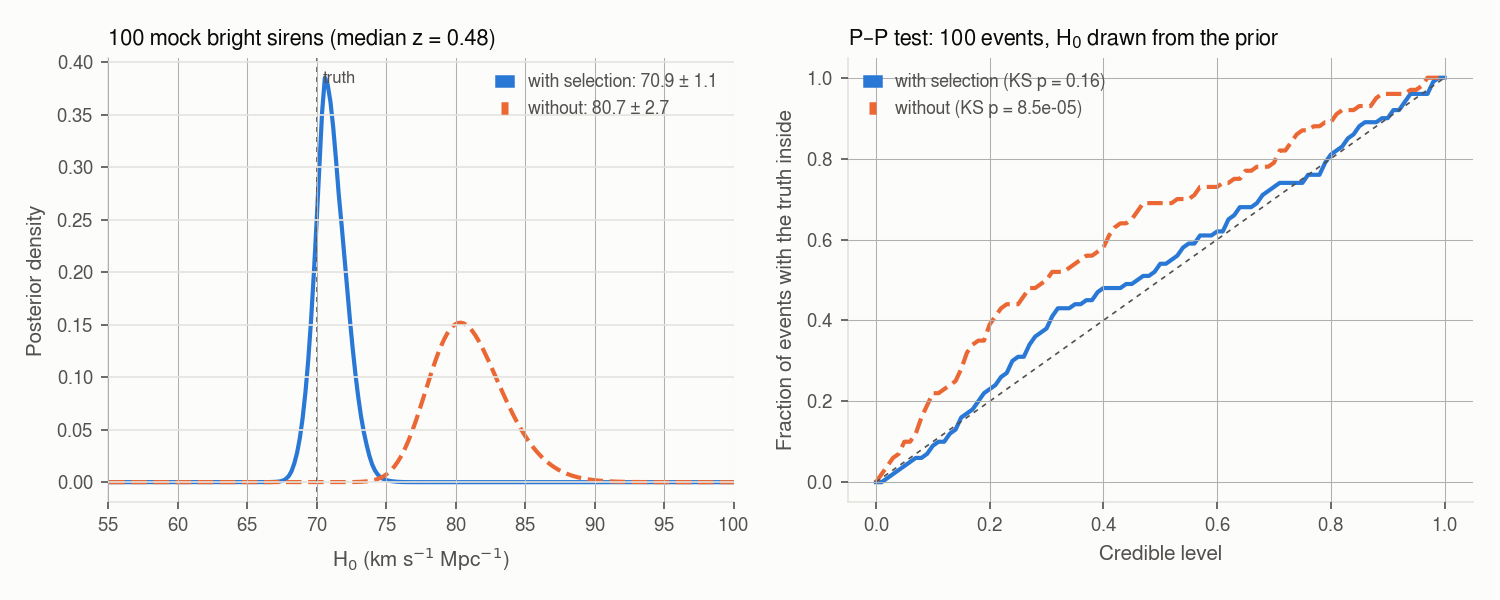
The injections must cover the population at every trial H₀. In a first version of the mock, with injection masses drawn from the population's own 20–40 M☉, β was wrong by up to a factor of 2.5 at the edges of the H₀ range, and H₀ was biased by 3σ. The LVK injections are drawn much more broadly than any population; the report gives the effective number of injections over the H₀ range.
Options
| Option | Default | Meaning |
|---|---|---|
--src-name |
GW170817 |
registered event (GW170817, GW190521) |
--pe-label |
the registry's, else all the labels (LowSpin first) | PE labels; the first one is the main result and the one combined |
--pe-file |
the event's bundle or Zenodo file | another PE file (PESummary layout) |
--pe-cache |
that of hubble_constant |
where Zenodo PE files are downloaded |
--v-recession V SIGMA, --v-peculiar V SIGMA |
the registry's | velocities of a nearby host, km/s |
--redshift Z SIGMA |
the registry's | Hubble-flow redshift of the host, instead of the velocities |
--selection |
auto |
euclidean, injections or auto |
--sensitivity-release, --sensitivity-file |
gwtc4 |
injections of the selection term |
--far-threshold, --snr-threshold |
0.25 /yr, 10 | found injections (real searches, semi-analytic O1+O2) |
--sky-radius |
3° | for samples not fixed to the counterpart |
--spectral-posterior |
none | spectral-siren posterior to combine with |
--h0-range MIN MAX |
10 200 | flat prior; keep the spectral siren's for a combination |
The published comparison is shown only with the registry's velocities or redshift.
Outputs
--out-report(HTML): the result, the caveat of a candidate counterpart, the inputs, the selection term and the plots;--out-summary(TSV): maximum a posteriori, 68.3% highest-density interval, median and 90% interval of each analysis, with the distance of each label;<summary>.posterior.tsv: the posterior densities on an H₀ grid;--plots-dir:h0_bright_siren_<event>.png, andh0_combined.pngwith--spectral-posterior.