Tidal deformability of neutron stars
This page explains how the tidal deformation of neutron stars is read from a gravitational-wave signal, what the public catalog files contain, and how spin enters the measurement. The posteriors are plotted with parameters_estimation.
The tidal deformability
In the last orbits before a merger, each neutron star is distorted by the tidal field \(\mathcal{E}_{ij}\) of its companion and acquires a quadrupole moment \(Q_{ij} = -\lambda\, \mathcal{E}_{ij}\) (Flanagan & Hinderer 2008 [63]). In dimensionless form,
where \(k_2\) is the tidal Love number and \(R\) the radius of the star (Hinderer 2008 [64]).
- \(\Lambda = 0\) for a black hole.
- For a 1.4 M☉ neutron star, \(\Lambda\) is of order 100–1000, depending on the equation of state (EOS) of dense matter. The \(R^5\) factor makes it a sensitive probe of the radius: a stiff EOS gives large, easily deformed stars.
How it shows up in the signal
The deformation takes energy out of the orbit, so the inspiral speeds up at the end. In the frequency-domain phase, the leading tidal term enters at 5PN order,
with \(\eta\) the symmetric mass ratio. Because of the \(x^5\) factor, almost all the information comes from above a few hundred Hz, in the last tens of cycles, where the detectors are limited by shot noise. The data constrain mainly the mass-weighted combination (Wade et al. 2014 [65])
while the second combination, \(\delta\tilde\Lambda\), enters at higher order and is essentially unconstrained. The LVK analyses use waveform models with tidal terms calibrated on numerical relativity, such as IMRPhenomPv2_NRTidal (Dietrich et al. 2017 [66]), and their NSBH counterparts IMRPhenomNSBH and SEOBNRv4_ROM_NRTidalv2_NSBH.
What the catalog files contain
Tidal parameters (lambda_1, lambda_2, lambda_tilde, delta_lambda) exist only in the labels
run with a tidal waveform. The default Mixed label of BNS and NSBH events has none, so the label
must be chosen with --pe-label. The values below are computed from the posterior samples
gwtc_analysis reads.
| Event | Tidal labels | \(\tilde\Lambda\): median, 90% upper bound |
|---|---|---|
| GW170817 (BNS) [40] | C02:IMRPhenomPv2_NRTidal-LowSpin, -HighSpin (unofficial bundle) |
406, ≤ 793 (low spin); 328, ≤ 746 (high spin) |
| GW190425 (BNS) [42] | C01:IMRPhenomPv2_NRTidal:LowSpin, :HighSpin |
398, ≤ 1247 (low spin); 986, ≤ 2063 (high spin) |
| GW200105, GW200115 (NSBH) [44] | C01:IMRPhenomNSBH:*, C01:SEOBNRv4_ROM_NRTidalv2_NSBH:* |
\(\Lambda_2\) uninformative |
| GW230529 (NSBH, mass-gap primary) [45] | C00:IMRPhenomNSBH, C00:SEOBNRv4_ROM_NRTidalv2_NSBH, C00:IMRPhenomPv2_NRTidalv2 |
\(\Lambda_2\) uninformative |
GW170817 is the only event with a real measurement. Assuming that both stars obey the same EOS, the LVK analysis finds \(\Lambda_{1.4} = 190^{+390}_{-120}\) and radii of about 11–13 km [69], [70]. This rules out the stiffest EOSs. Combined with the kilonova AT2017gfo, some authors also derive a lower bound \(\tilde\Lambda \gtrsim 400\) [71], but this bound depends on the ejecta models and is debated.
GW190425 is heavier (about 3.4 M☉ in total) and was seen essentially by LIGO Livingston alone at lower SNR, so it gives only a weak upper bound.
NSBH events. The NSBH models fix \(\Lambda_1 = 0\) for the black hole, and the heavy primary
dominates the mass weighting, so lambda_tilde comes out small (median ~20–150) whatever the
neutron star is: it is not a measurement. The informative quantity is lambda_2, which for these
events stays close to its flat 0–5000 prior (median ~2500). With a large mass ratio and a slowly
spinning black hole, the neutron star plunges before it is tidally disrupted, which also explains
why no electromagnetic counterpart was expected. For GW230529, C00:IMRPhenomPv2_NRTidalv2 instead
treats both objects as neutron stars (\(\Lambda_1 \neq 0\)).
Spin and tides
The tidal effect itself does not depend on spin, but its measurement does, in three ways.
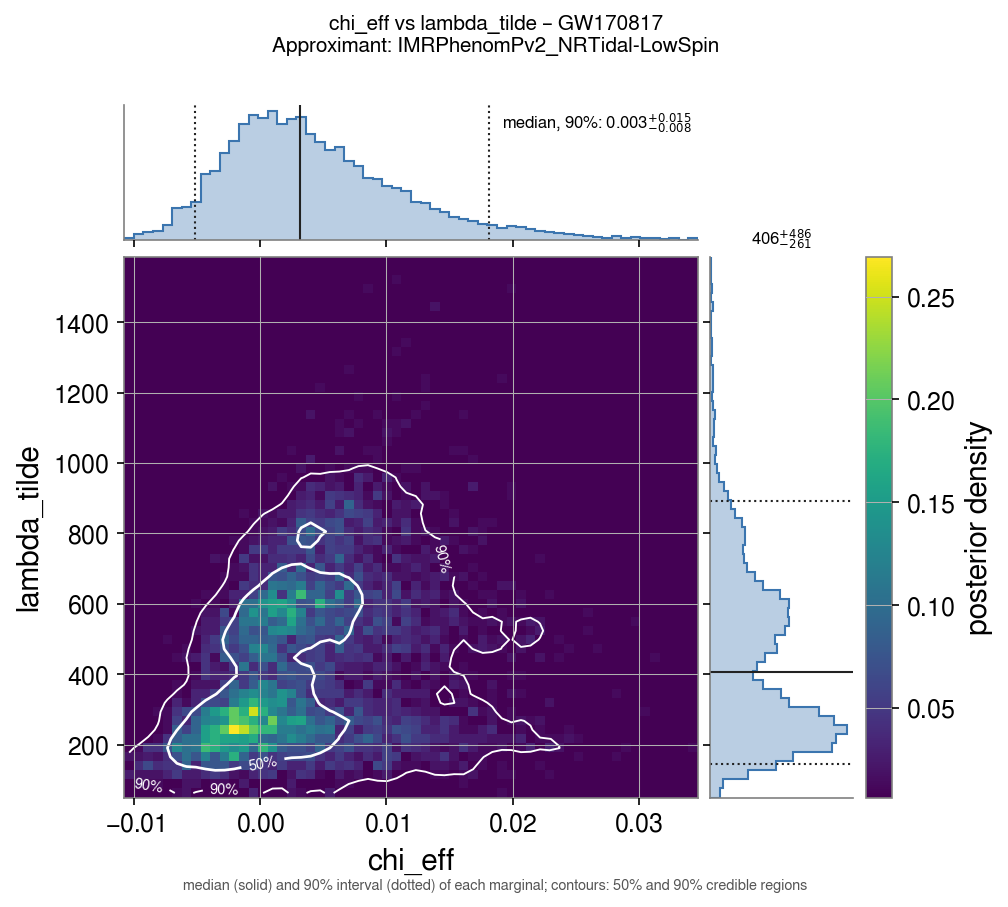
Mass ratio–spin degeneracy. The aligned spin \(\chi_\text{eff}\), which enters the phase at 1.5PN order, is correlated with the mass ratio \(q\). Because \(\Lambda\) depends steeply on mass, a wider spin prior spreads \(q\), and with it \(\Lambda_1\) and \(\Lambda_2\). The LVK therefore publishes two analyses:
- LowSpin, \(|\chi| \le 0.05\): the spins of the fastest Galactic double neutron stars, spun down to the time of merger;
- HighSpin, \(|\chi| \le 0.89\): agnostic, giving broader and more asymmetric bounds.
The correlation is visible directly in the GW170817 posterior:
gwtc_analysis parameters_estimation --src-name GW170817 \
  --pe-label C02:IMRPhenomPv2_NRTidal-LowSpin \
  --pe-vars lambda_tilde delta_lambda lambda_1 lambda_2 \
  --pe-pairs lambda_1:lambda_2 chi_eff:lambda_tilde mass_ratio:lambda_tilde
Spin-induced quadrupole. A spinning star is flattened, which gives it a quadrupole moment \(Q = -\kappa\, \chi^2 m^3\) entering at 2PN order through the spin–spin terms. \(\kappa = 1\) for a black hole and about 2–14 for a neutron star, depending on the EOS. The waveform models do not fit \(\kappa\) separately: they tie it to \(\Lambda\) through the quasi-universal Love–Q relations (Yagi & Yunes 2013 [67]). For low spins the effect is small.
No tidal spin-up. Tidal torques could in principle lock the stars' rotation to the orbit, but the viscosity of neutron-star matter is far too low for this to happen before the merger (Bildsten & Cutler 1992 [68]). The stars stay essentially irrotational, as the tidal models assume.
Practical notes
- BNS signals are long, so a
parameters_estimationrun with the strain overlays takes several minutes (about 7 min for GW170817). - The log lists the labels available in the PE file, and the report flags any requested variable that the selected label does not have.