search_skymaps
Which events could come from a given direction? For each event of the chosen catalogs, the mode
reads its sky localization (HEALPix FITS skymap) and tests whether the position (--ra-deg,
--dec-deg) lies inside the credible region --prob (0.9 for the 90% region). With --counterparts, it
searches instead for gamma-ray bursts and neutrinos coincident with each event
(multi-messenger coincidences).
gwtc_analysis search_skymaps --catalogs GWTC-4 --ra-deg 265.0 --dec-deg -46.0 --prob 0.9
--skymap-labelchooses the analysis whose skymap is used, one map per event:Mixed, the combined samples, by default. An event without a map for that label falls back toMixed, then toIMRPhenomXPHM_SpinTaylor: GWTC-5.0 has noMixedmaps, so its events use the IMRPhenomXPHM-SpinTaylor map, the only waveform run on all of them; then to the other waveforms in a fixed order (Method).anysearches every map of every event (with--counterparts, one map per event, asMixed).- GWTC-1 events are covered by the GWTC-2.1 skymap release;
ALLexpands to GWTC-2.1, GWTC-3, GWTC-4 and GWTC-5. - Skymaps come from
--data-repo: the Zenodo tarballs (a given version with--zenodo-version), the S3 bucket, or Galaxy collections.
The catalog skymaps are built by the LVK from the PE posterior samples; see Singer et al. 2016 [56] for the three-dimensional skymap format.
Method
The mode reads the released skymaps; it builds no skymap and runs no localization. It computes a
credible level from each map at a given position, or, with --counterparts, scores the entries of public
burst and neutrino catalogs against each map.
What it reads
| Input | Source | What is in it |
|---|---|---|
| GW skymaps | the skymap tarball of each catalog's Zenodo PE release (latest version, or --zenodo-version); with s3 or galaxy, the maps of the same release on the mirror when it holds them |
HEALPix FITS maps built by the LVK from the PE samples, one per event and waveform analysis, with the distance layers |
| GWTC-1 events | the GWOSC list GWTC-1-confident | the event names kept from the GWTC-2.1 release |
external catalogs (--counterparts) |
HEASARC TAP (fermigbrst, swiftgrbba, icecubepsc) and the GCN table of IceCube Gold and Bronze alerts |
times, positions and errors (table below) |
GW false-alarm rates (--counterparts) |
the GWOSC confident and marginal lists | FAR and GPS time of each event |
What the mode does: a position
- Download each tarball once into
.cache_gwosc/in the working directory, and index its maps by event and waveform label, taken from the file names. - One map per event: the
--skymap-labelmap, elseMixed, else IMRPhenomXPHM-SpinTaylor, then the other waveforms in a fixed order (IMRPhenomXPHM, IMRPhenomXPNR, NRSur7dq4, SEOBNRv5PHM, SEOBNRv4PHM), else the first by name;anykeeps every map. - Credible level of the position: the map is read with
ligo.skymap.io.fits.read_sky_mapas a single-resolution HEALPix map, andhealpy.ang2pixgives the pixel containing (ra, dec). The pixels are sorted by decreasing probability; the cumulative sum at that pixel is its greedy credible level, in percent. The position is inside when this level is at or below 100 ×--prob. The result has the resolution of the pixel; nothing is interpolated. - Hits only are plotted (Mollweide projection of
ligo.skymap, contours at 50%, 90% and--prob); every map searched gets a row in the TSV.
With --counterparts
- External catalogs are downloaded into
~/.cache_gwtc_analysis/coincidence/(or$GWTC_COINCIDENCE_CACHE) and refreshed after 7 days or with--refresh-catalogs. The IceCube point-source events are queried per merger, over ±12 h, and their rate is taken from those 24 h; for the other catalogs, the rate R is the number of entries over the span of the catalog, which also defines the mergers it covers. - Errors as a Gaussian σ: a 90% radius is divided by 2.146; the GBM 1σ error gets its 3.7° systematic in quadrature (an error of 0, a position taken from a counterpart, stays 0).
- GW maps come from Zenodo only, one per event with the label and fallback above (
anyacts asMixedhere), or from the--skymapfiles. Each is resampled to NSIDE 256 (0.23° pixels), multi-order maps withligo.skymap.bayestar.rasterize; the merger time is thegps_timeof the FITS header, and the FAR is that of the GWOSC event within 2 s of it. - Statistic as in Multi-messenger coincidences: the smoothing is
healpy.smoothingwith the counterpart's σ (none below half a pixel), and \(q\) is counted exactly over all the pixels. For a burst, the line-of-sight distance follows \(p(r) \propto r^2 \mathcal{N}(r; \mu, \sigma)\) with the map'sDISTMUandDISTSIGMAat its pixel. - Summary per catalog: the smallest \(p\) over N maps becomes \(1 - (1 - p_\text{min})^N\), and the
maps below \(p = 0.01\) are compared with the 0.01 N expected.
--probsets only which coincidences are counted as inside the GW region and plotted.
Example: an event seen by three detectors
gwtc_analysis search_skymaps --catalogs GWTC-1 --ra-deg 341.28 --dec-deg 21.66 --prob 0.9
The position is the most probable point of GW170818_022509, a binary black hole observed by H1, L1 and Virgo in August 2017. GWTC-1 has no skymap release of its own: the mode reads the GWTC-2.1 skymaps and keeps the 10 GWTC-1 events they contain (GW170817, a binary neutron star, is not in the GWTC-2.1 re-analysis). Only GW170818 contains the position in its 90% region, at the 0.03% credible level, its peak; for the 9 others it lies outside the 99.9% region.
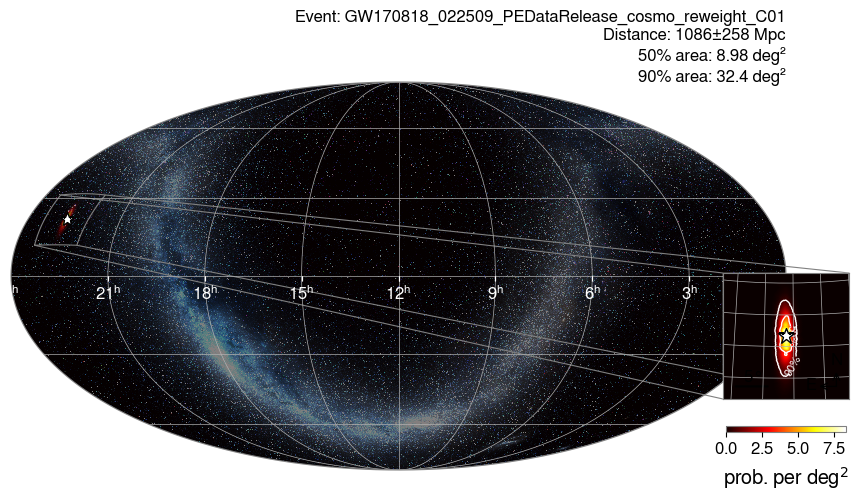
GW170818_022509: with three detectors, the 90% region of the PE skymap covers 32 deg², the small red area around the star (upper left), enlarged in the zoom (right); two detectors give thousands of deg².
For comparison, a single-detector event:
gwtc_analysis search_skymaps --catalogs GWTC-4 --ra-deg 265.0 --dec-deg -46.0 --prob 0.9
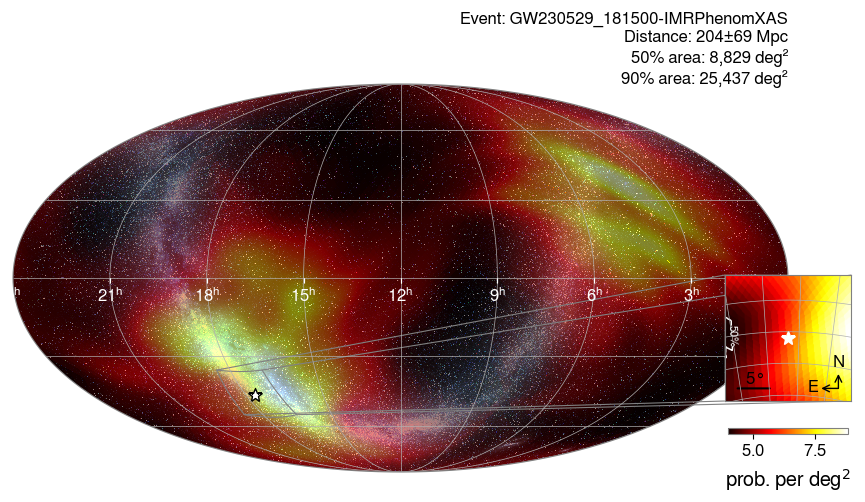
GW230529_181500, seen by L1 alone: its 90% region covers 25 400 deg², more than half of the sky, and contains the position (star) at the 16% credible level. The same position is inside the 90% region of 13 of the 86 GWTC-4.0 skymaps.
Multi-messenger coincidences
gwtc_analysis search_skymaps --counterparts grb neutrino --catalogs ALL          # every catalog event
gwtc_analysis search_skymaps --counterparts grb --skymap bayestar.multiorder.fits  # a GraceDB alert map
An offline version of what the LVK's RAVEN does within minutes for each public alert: for every GW sky map, the gamma-ray bursts and neutrinos recorded within a time window of the merger, scored by how well their position overlaps the GW localization. The external catalogs are public and downloaded once a week:
--sources |
Messenger | Catalog | Covers | Localization | Window |
|---|---|---|---|---|---|
gbm |
GRB | Fermi-GBM burst catalog (HEASARC fermigbrst) |
July 2008 onwards, about 240 bursts per year | statistical 1σ and a 3.7° systematic in quadrature | −1 to +5 s, RAVEN's |
swift |
GRB | Swift bursts of the burst advocates (HEASARC swiftgrbba) |
December 2004 onwards, about 90 per year | the best of UVOT, XRT and BAT (90% radii), with the redshift and host galaxy when measured | −1 to +5 s |
icecube-alerts |
neutrino | IceCube Gold and Bronze alert tracks (GCN) | from the start of the stream, 17 June 2019, about 27 per year | 90% statistical radius | ±500 s |
icecube-events |
neutrino | IceCube point-source event list (HEASARC icecubepsc) |
2008 to July 2018: O1 and O2 | 1σ | ±500 s |
--grb-window and --neutrino-window change the windows; --skymap FILE searches given maps (a GraceDB
alert during a run, or GW170817's GWTC-1 map, which no PE release holds) instead of, or besides, --catalogs.
Statistic. For a counterpart at (ra, dec) with localization σ:
- the credible level of the GW map at its position;
- the overlap \(I_\Omega = N_\text{pix} \sum p_\text{GW}\, p_\text{ext}\): the GW probability its localization covers, relative to a uniform sky (1 for an unrelated direction, \(N_\text{pix}\, p_\text{GW}\) for a point), computed by smoothing the GW map with a Gaussian of width σ;
- \(q\), the fraction of isotropic positions (same σ) with a larger overlap, from the same smoothed map;
- the chance probability \(p = 1 - e^{-R\,\Delta t\, q}\): that the catalog, at its rate R, puts a counterpart this well placed in the window Δt by chance; for the best counterpart of a map, the map's chance probability;
- RAVEN's coincidence false-alarm rate \(\text{FAR}_\text{GW}\, R\, \Delta t / I_\Omega\), when the GW FAR is in the GWOSC lists;
- for a gamma-ray burst, the speed of gravity it implies if it is the same source: the gamma rays left 0 to 10 s after the merger and travelled at least \(D\), the 5% quantile of the GW distance along their line of sight (the distance layers of the 3D sky map), so \(c(\Delta t - 10\,\text{s})/D \le (v_\text{GW} - c)/c \le c\,\Delta t / D\), the method of the GW170817 paper (ApJL 848, L13).
The report counts the maps with \(p < 1\%\) against the number expected by chance, and corrects the smallest \(p\) for the number of maps searched.
Result for GWTC-2.1 to GWTC-5.0 and GW170817 (281 maps):
| Source | Maps covered | With a counterpart in the window | Result |
|---|---|---|---|
| Fermi-GBM | 281 | 1 | GRB 170817A, 2.0 s after GW170817, at its 36% credible level: overlap 3.7 × 10³, \(p = 4 \times 10^{-9}\), RAVEN FAR 1.2 × 10⁻¹⁵ per year |
| Swift | 281 | 0 | |
| IceCube alerts | 252 (from June 2019) | 0 | no alert track within ±500 s of any merger |
| IceCube events | 11 (O1, O2) | 11 | 2 to 7 events per window, the background rate; none inside a 90% region, the best at the 97% level of GW170104 (\(p = 0.12\)) |
GW170817 remains the only multi-messenger event, as published. The absence of neutrinos agrees with IceCube's own searches, made with its internal data, which are deeper than the public lists: none for GW170817 (its jet seen off-axis), none for the O3 candidates (joint IceCube–LVK LLAMA search, ApJ 1003, 41 (2026)), none for the 1030 O4a alerts (IceCube, arXiv:2606.13762).
Speed of gravity from GW170817. The burst arrived 2.05 s after the merger in the catalog (the GBM trigger time; the GW170817 paper's 1.74 s is the delay to the onset of the burst), from at least 28 Mpc along its line of sight: \(-2.8 \times 10^{-15} \le (v_\text{GW} - c)/c \le +7.2 \times 10^{-16}\), against \(-3 \times 10^{-15}\) to \(+7 \times 10^{-16}\) published (1.74 s and 26 Mpc; with 1.74 s, the mode gives \(+6.1 \times 10^{-16}\)).
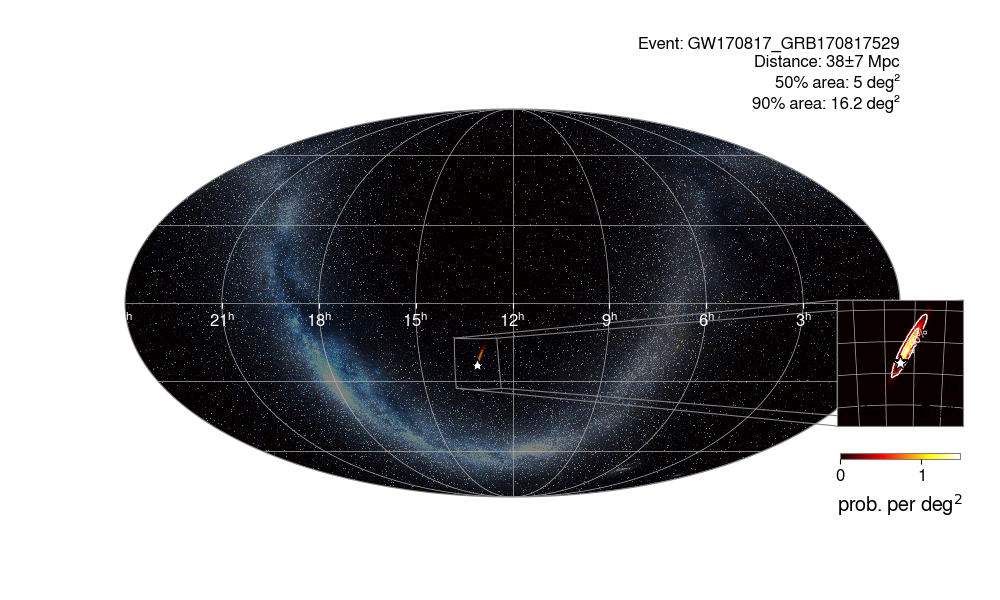
GW170817 (GWTC-1 map, 16 deg² at 90%) and the position of GRB 170817A in the Fermi-GBM catalog.
Caveats.
- The Fermi-GBM catalog replaces the GBM position by the counterpart's when one was localized: GRB 170817A carries the position of AT2017gfo, error 0. Its overlap is therefore that of the kilonova, not of the GBM localization: with GBM's own region (about 1100 deg² at 90%, σ ≈ 9°) the overlap would be about 80 and \(p \approx 3 \times 10^{-8}\), still a clear coincidence.
- The public neutrino lists are the alert tracks (O3, O4) and the point-source events (O1, O2); IceCube's own coincidence searches use deeper samples, so a null here is weaker than theirs.
- Sub-threshold triggers are not in the catalogs. RAVEN, in low latency, also uses the sub-threshold triggers of Swift-BAT and Fermi-GBM, which no public burst catalog lists. S241125n (GW241125_010116 in GWTC-5.0), a binary black hole candidate with a sub-threshold Swift trigger and a RAVEN joint FAR of about 1 per 1000 yr (1 per 6 yr with the rate of binary black holes folded in; GCN 38315, 38356; arXiv:2505.10395), is found here with no burst, as it should be: such candidates come only from the alert stream.
- The catalog trigger time is not the onset of the burst: for GRB 170817A, 2.05 s against 1.74 s.
- The windows suit prompt emission (GRBs, −1 to +5 s) and the neutrinos of the jets (±500 s); longer delays (choked jets, flares of an AGN disk) need wider windows.
From a coincidence to a bright siren. A Swift burst with an afterglow, inside the GW map, gives a position to
arcseconds and, when measured, the redshift of its host (columns redshift and host_galaxy). The event can then
be run as a bright siren with that counterpart, and the jet seen nearly on-axis as a viewing-angle constraint:
hubble_constant --method bright --event <name> --ra ... --dec ... --redshift Z SIGMA --viewing-angle 10 5
(bright siren).
Outputs
--out-events (TSV) lists every event with the credible level of the position; the
events that contain it are plotted in --plots-dir and gathered in --out-report.
With --counterparts: coincidences.tsv (one row per coincident burst or neutrino), coincidences.events.tsv
(one row per event), coincidences.html and coincidence_plots/.
Options
| Option | Default | Meaning |
|---|---|---|
--catalogs |
— | Catalog keys, space-separated (e.g. GWTC-1 GWTC-2.1 GWTC-3 GWTC-4 GWTC-4.1 GWTC-5). ALL takes them all except the updates (GWTC-4.1, update of GWTC-4), which are used only when named. |
--ra-deg |
— | Right ascension (deg); not with --counterparts. |
--dec-deg |
— | Declination (deg); not with --counterparts. |
--counterparts {grb,neutrino} |
— | Search the GRB and/or neutrino coincidences of each GW map instead of a position. |
--sources {gbm,swift,icecube-alerts,icecube-events} |
— | With --counterparts: the external catalogs (default: all those of the messengers). |
--grb-window START END |
— | With --counterparts: GRB time window around the merger, s (default -1 5, as RAVEN). |
--neutrino-window START END |
— | With --counterparts: neutrino time window around the merger, s (default -500 500). |
--skymap FILE |
— | With --counterparts: GW sky map files (FITS) to search, e.g. a GraceDB alert map. |
--refresh-catalogs |
off | With --counterparts: download the external catalogs again (otherwise weekly). |
--prob |
0.9 |
Credible-level threshold (above 0, at most 1). Common values: 0.9, 0.5, 0.95. |
--skymap-label |
Mixed |
Analysis whose skymap is used, one per event (default: Mixed; without one, Mixed, then IMRPhenomXPHM_SpinTaylor, the GWTC-5.0 case, then the other waveforms in a fixed order). 'any': every map of every event; with --counterparts, any acts as Mixed. |
--out-events |
search_skymaps.tsv (coincidences.tsv with --counterparts) |
Output TSV file. |
--out-report |
search_skymaps.html (coincidences.html with --counterparts) |
Output HTML report path for hits. |
--plots-dir |
sky_plots (coincidence_plots with --counterparts) |
Directory for hit plots. |
--data-repo {galaxy,zenodo,s3} |
zenodo |
Where the skymaps are read from: zenodo (the release tarballs); s3 (the MinIO mirror, faster) or galaxy (staged collections, else the public usegalaxy.org history), when they hold the maps of the selected release version, else Zenodo. |
--zenodo-version CATALOG=VERSION |
— | Read an older Zenodo release version of a catalog instead of the latest, with any --data-repo (e.g. --zenodo-version GWTC-3=v2 GWTC-4=v1). Versions are numbered from the oldest (v1); list them with the zenodo_releases mode. |
Every report ends with the options of its run, defaults included. The same table with the help text of all the modes: CLI reference.