parameters_estimation
Everything about one event: its posterior distributions, the whitened strain of each detector with the best-fit waveform overlaid, a q-transform (time–frequency map), and the matched-filter SNR.
gwtc_analysis parameters_estimation --src-name GW231223_032836
gwtc_analysis parameters_estimation --src-name GW150914_095045 \
    --pe-vars chi_eff chi_p --pe-pairs mass_1_source:mass_2_source
Posterior samples
The event's PESummary PEDataRelease file is read from --data-repo. It holds several analyses,
called labels (C00:Mixed, C00:IMRPhenomXPHM-SpinTaylor, C00:SEOBNRv5PHM, …), each with its
posterior samples, priors, PSDs, calibration envelopes and configuration. --pe-vars adds 1-D
posteriors and --pe-pairs 2-D ones (x:y).
Choosing --pe-label and --waveform-engine
The mode distinguishes which label is read (posteriors and metadata) from which waveform engine synthesizes the signal of the strain overlay.
--pe-labelgiven: that label is used for the posteriors, and as the source of the PSDs and of the maximum-likelihood parameters of the overlay.- Only
--waveform-enginegiven: the label whose name best matches the engine (substring match, no hard-coded mapping) is used for everything.--waveform-engine IMRPhenomXPHMselectsC00:IMRPhenomXPHM-SpinTaylorif present. - Neither: the
Mixedlabel for the posteriors (the plainCxx:Mixedone when there are variants such asMixed:NSBH:*). The strain overlay needs a PSD, which theMixedlabels of the Zenodo releases do not carry: it then uses theIMRPhenomXPHMlabel, else the first label with a PSD. Files without aMixedlabel (the GW170817 bundle) use their first label.
If the requested engine cannot be instantiated (for instance outside its parameter range), the mode logs a warning, falls back to another engine when possible, and reports both the requested and the used engine in the logs and plot titles.
Strain overlay and q-transform
The strain around the event is downloaded from GWOSC, whitened with the PSD of the label, band-passed, and the maximum-likelihood waveform projected on each detector is overlaid. The time windows and frequency bands have shared defaults and per-product overrides:
| Applies to | Options |
|---|---|
| both products | --start, --stop (seconds before and after the merger), --fmin, --fmax |
| overlay only | --overlay-start, --overlay-stop, --overlay-fmin, --overlay-fmax |
| q-transform only | --q-start, --q-stop, --q-fmin, --q-fmax, --q-fscale {linear,log} |
When the posterior is BNS-like (median chirp mass below 5 M☉), the windows not set explicitly switch to a BNS profile: longer windows and a wider frequency range.
The waveform is aligned to the data in time and phase with the matched filter below, so that the overlay stays coherent even when the stored maximum-likelihood extrinsic parameters are approximate.
Matched-filter SNR
For each detector, the maximum-likelihood projected waveform is matched-filtered against the strain (PyCBC; Allen et al. 2012 [53], Usman et al. 2016 [54]). The resulting |ρ(t)| should peak at the coalescence time, at about the detector's recovered SNR.
- The strain is conditioned the standard PyCBC way (high-pass at 15 Hz, resampled to 2048 Hz, edges cropped of filter transients), so that the off-source |ρ(t)| has unit-scale RMS (~0.7). A guard warns if it strays from that range.
- Loud glitches are gated out before filtering, and the SNR is only reported where the matched filter is valid.
- Short (BBH-like) signals only. A single template cannot coherently recover a long BNS inspiral: over thousands of cycles, small parameter and phase differences accumulate and the SNR is lost (that requires a template bank). When the template is longer than the conditioned data, the matched-filter SNR is skipped with a warning; the other products are still made.
Higher multipoles and precession
From GWTC-4.0 on, the PE samples store four SNRs, and the report summarizes them for every label of the
file (the plot and the verdict are for the label of the posterior plots, --pe-label):
network_33_multipole_snr,network_44_multipole_snr,network_21_multipole_snr(ρ₃₃, ρ₄₄, ρ₂₁): the SNR of the (3,3), (4,4) and (2,1) multipoles orthogonal to the (2,2) one, the part a change of the other parameters cannot absorb (Mills & Fairhurst 2021 [77]). These multipoles are strong for unequal masses and inclined orbits; they measure the mass ratio, break the distance–inclination degeneracy and test GR.network_precessing_snr(ρp): a precessing signal is close to the sum of two non-precessing harmonics, and ρp is the SNR of the weaker one (Fairhurst et al. 2020 [78]). Precession comes from spins tilted against the orbit, a sign of dynamical formation.
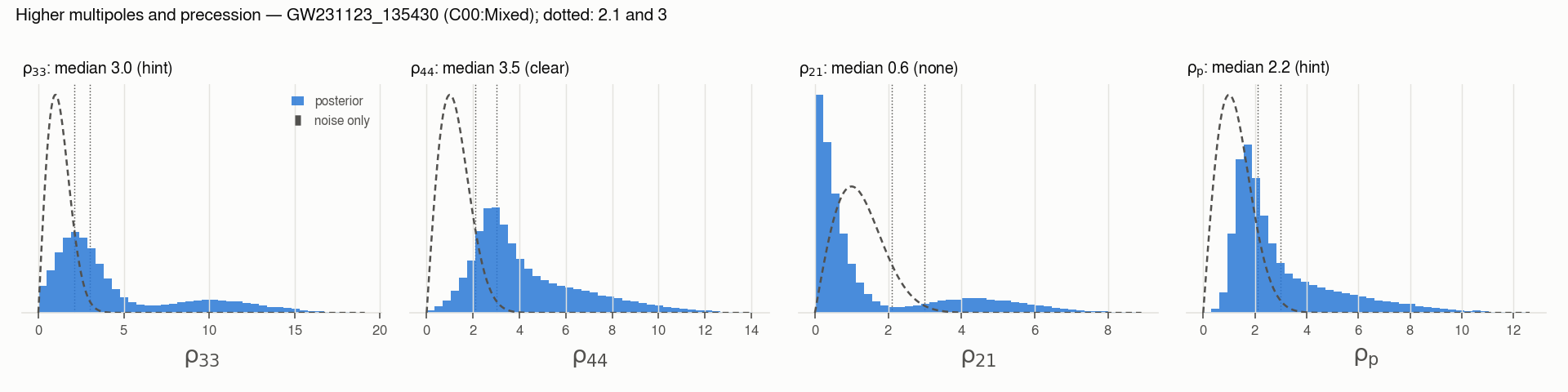
Without the multipole (or precession), ρ² follows a χ² distribution with 2 degrees of freedom, so ρ
follows a Rayleigh distribution: P(ρ > 2.1) = 11%, P(ρ > 3) = 1%. The report classes the posterior
medians as clear (≥ 3) or a hint (2.1–3), and plots the posteriors of the selected label against
the noise-only distribution. This is the noise-only scale: the LVK papers compare with the distribution
of ρ under the prior, which needs prior samples that the files do not contain. When the labels' medians
differ by more than 1, the report says that the waveform models disagree. The table is also written to
<event>_multipoles_precession.tsv.
The GWTC-1 to GWTC-3 files do not store these SNRs (so GW190412, GW190814 and GW200129, whose higher multipoles or precession were reported, cannot be checked this way); the report says so.
Example: GW231123_135430, the most massive binary of GWTC-4.0:
| Label | ρ₃₃ | ρ₄₄ | ρp |
|---|---|---|---|
C00:Mixed (default) |
3.0 | 3.5 | 2.2 |
C00:NRSur7dq4 |
2.6 | 3.5 | 2.3 |
C00:SEOBNRv5PHM |
2.6 | 3.2 | 2.0 |
C00:IMRPhenomTPHM |
2.1 | 2.8 | 1.7 |
C00:IMRPhenomXPHM-SpinTaylor |
10.5 | 7.3 | 5.2 |
With the default C00:Mixed, the (4,4) multipole is clear and the (3,3) multipole and precession are hinted.
The (4,4) evidence holds with NRSur7dq4 and SEOBNRv5PHM too (3.5 and 3.2). But IMRPhenomXPHM-SpinTaylor
finds a loud (3,3) multipole and strong precession that the other models do not. The LVK analysis of this event found large waveform systematics, and the multipole content is
where they show. Most events have ρ well below 2: binaries of similar masses seen close to face-on,
which suppresses both effects.
Missing PSDs
A few official PE files have no PSDs. They are then taken from public supplementary releases: see Known issues in the public releases.
GW170817
GW170817 has no catalog PE file. The mode transparently uses the bundle rebuilt from public GWTC-1 products: see build_unofficial_pe.
Tidal deformability
For BNS and NSBH events, the tidal parameters (lambda_1, lambda_2, lambda_tilde,
delta_lambda) are only in the labels run with a tidal waveform, not in Mixed: select one with
--pe-label.
gwtc_analysis parameters_estimation --src-name GW170817 \
    --pe-label C02:IMRPhenomPv2_NRTidal-LowSpin \
    --pe-vars lambda_tilde lambda_2 --pe-pairs chi_eff:lambda_tilde
Which events carry them, how to read them (for NSBH events, lambda_2 rather than lambda_tilde)
and how spin enters the measurement: see
Tidal deformability of neutron stars.
Example: GW150914
gwtc_analysis parameters_estimation --src-name GW150914_095045 \
    --pe-vars chi_eff luminosity_distance --pe-pairs mass_1_source:mass_2_source
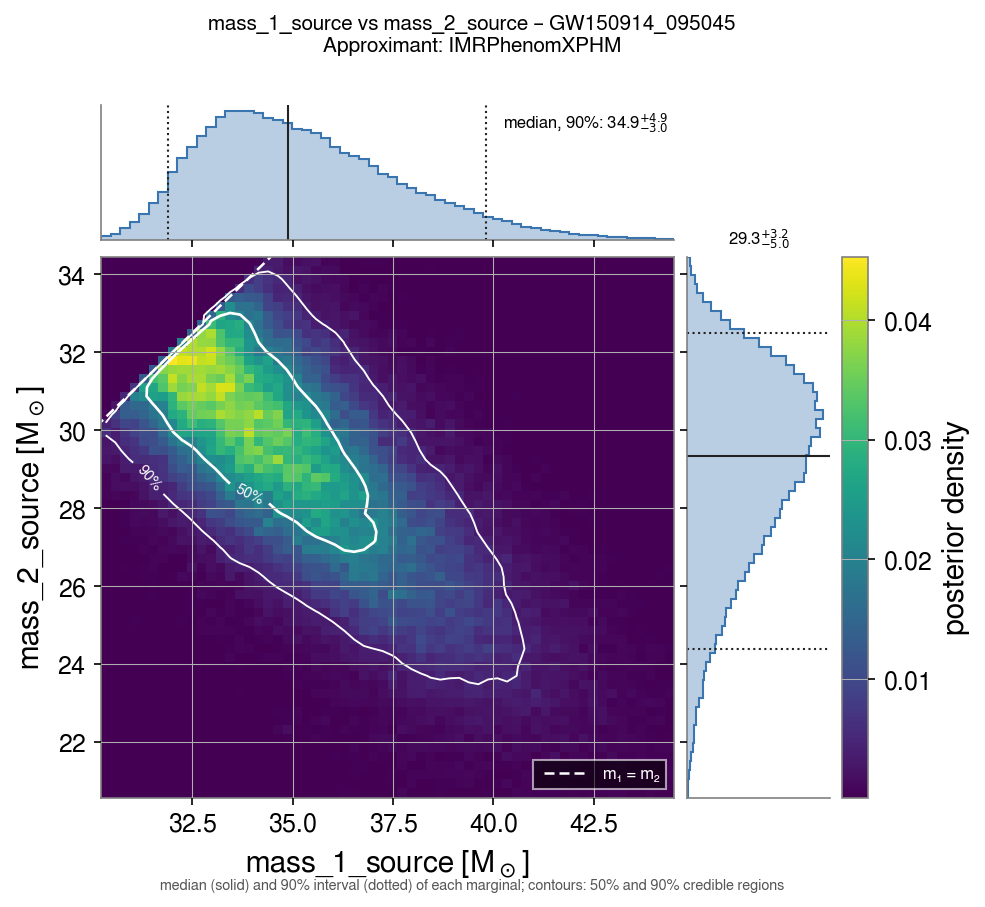
The first detection, from the GWTC-2.1 PE release; all the figures below come from this command.
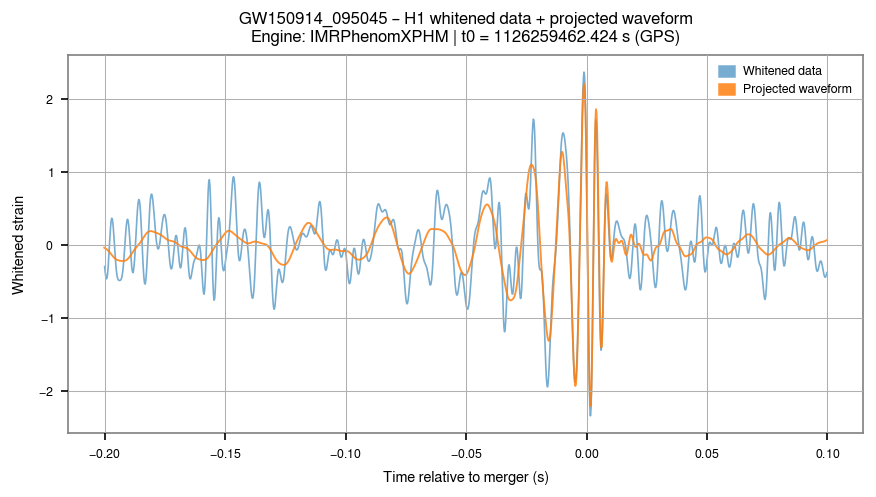
H1 strain, whitened and band-passed, with the maximum-likelihood IMRPhenomXPHM waveform projected on the detector and aligned by the matched filter.
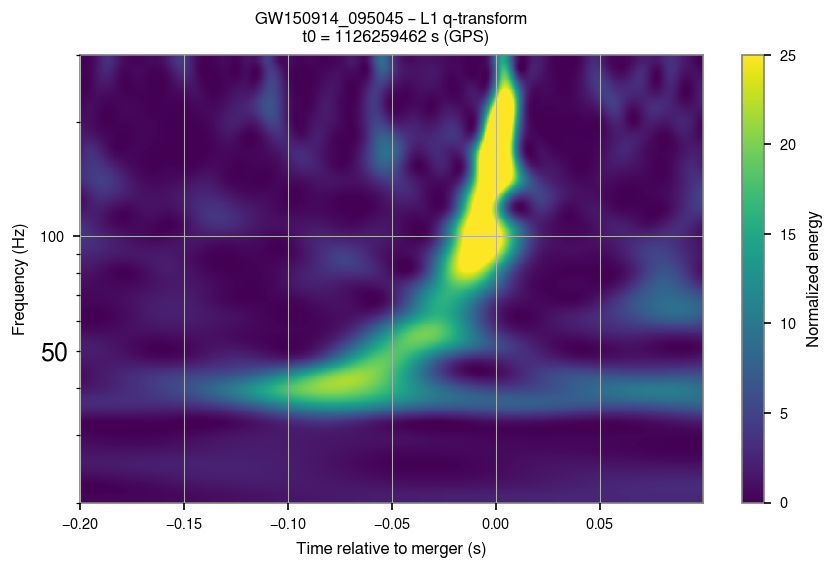
L1 q-transform: the chirp rises from about 35 Hz to over 200 Hz in about 0.1 s.
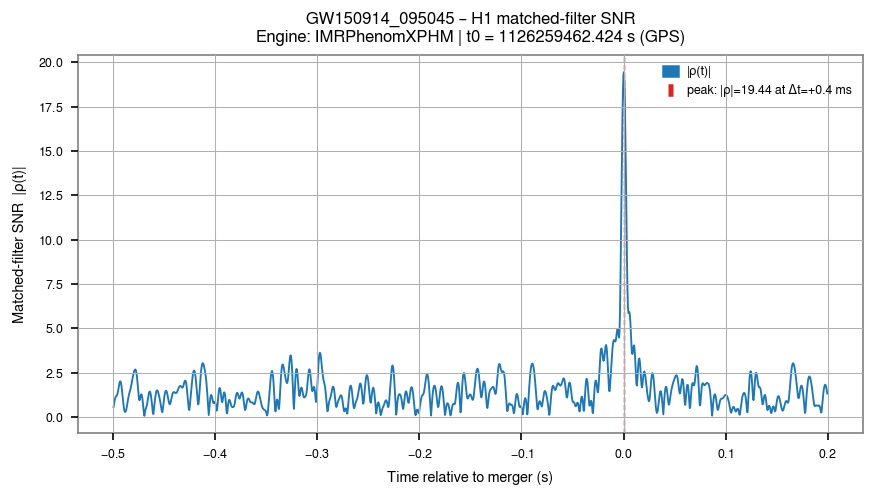
Matched-filter SNR |ρ(t)|: a peak of 19.4 in H1 (13.9 in L1) at the coalescence time, over noise of unit-scale RMS.
| Source-frame masses | Sky localization |
|---|---|
 |
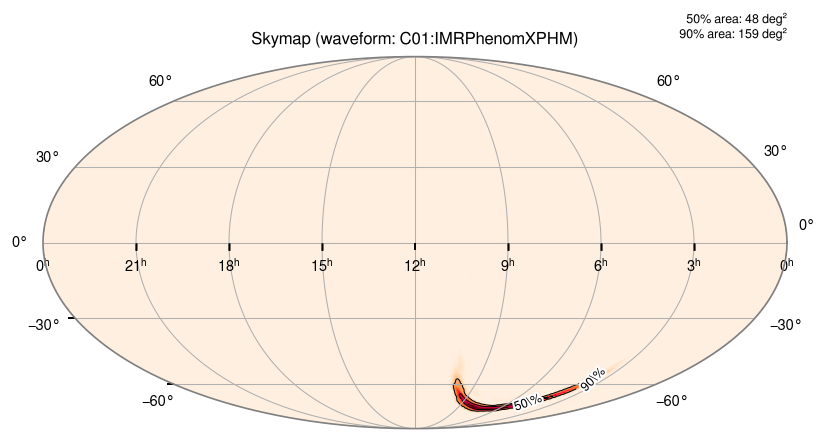 |
Posterior of the source-frame masses: medians 34.9 and 29.3 M☉, with the 50% and 90% credible regions and the density peaking close to equal masses. The samples stop at the dashed line m₁ = m₂, since the primary is by convention the heavier component; the band follows a line of nearly constant chirp mass, the best-measured mass parameter. Right: the skymap of the IMRPhenomXPHM analysis, 159 deg² at 90% with the two LIGO detectors.
All options: CLI reference.