continuous_waves
Continuous waves (CW) are long-lived, nearly monochromatic signals: from spinning neutron stars with a small deformation (a "mountain", of ellipticity ε), or from clouds of ultralight bosons around spinning black holes, which annihilate into gravitons at twice the boson's Compton frequency. None has been detected. The mode gathers the upper limits of the LVK data releases and shows them as the papers do, with the boson mass found by scalar_cloud for GW190728 drawn on the boson-cloud limits. It runs no search itself (see Method).
gwtc_analysis continuous_waves                                  # downloads 3 MB once
gwtc_analysis continuous_waves --boson-mass 2e-13 3e-13 4e-13 --boson-label "my band"
Method
The mode runs no continuous-wave search. It reads no strain data and reruns none of the LVK pipelines: those searches take months of detector data and large computing campaigns. It reads the upper limits the LVK published with each paper (data releases on the LIGO DCC), draws them as the papers do, and derives from them the few numbers of the Results, each compared with the paper.
What the LVK searches did
| Search | Data | Pipelines | Upper limit |
|---|---|---|---|
| 45 known pulsars, O4a [105] | O4a, the two LIGO detectors | three independent targeted pipelines, which follow the phase of each pulsar from its radio or X-ray timing: the time-domain Bayesian method (CWInPy: a heterodyne removes the phase evolution of the source, then the amplitude is sampled), the 5n-vector method, and the time-domain \(\mathcal{F}\)/\(\mathcal{G}\)/\(\mathcal{D}\)-statistic; and the 5n-vector narrowband pipeline for 16 of the pulsars, which lets the frequency and spin-down wander slightly around the timing values | on the strain amplitude h₀ at twice the rotation frequency (single-harmonic emission): a 95% credible upper limit from the posterior (Bayesian), 95% confidence from software injections (the other pipelines) |
| all-sky, isolated neutron stars, O4a [106] | O4a, 20–2000 Hz | three semi-coherent all-sky pipelines, which search every sky position, frequency and spin-down: PowerFlux (templated, with a loose-coherence follow-up), FrequencyHough (templated), SOAP (a hidden Markov model, without templates) | 95% confidence, frequentist, against frequency; PowerFlux averaged over the sky positions and orientations of the population |
| all-sky, boson clouds, O3 [107] | O3, the two LIGO detectors, 20–610 Hz | one semi-coherent search of the Band Sampled Data (BSD) framework, at several Fourier-transform lengths (a cloud's frequency rises slowly and may fluctuate); outliers found in both detectors, followed up with FrequencyHough or a hidden-Markov-model tracking | 95% confidence per 1 Hz band, from the analytic FrequencyHough sensitivity with the measured noise and the largest detection statistic (critical ratio) of each band. The paper then turns them into the excluded black-hole and boson masses, from the signal model, for a fixed distance (1 or 15 kpc), initial black-hole spin (0.5 or 0.9) and cloud age, and into the largest distance at which clouds are excluded, from a simulated population of black holes (masses with a Kroupa distribution, \(m^{-2.3}\), from 5 to 50 or 100 M☉; spins uniform from 0.2 to 0.9) |
The spin-down limit is the strain a pulsar would emit if all the rotational energy it loses went into gravitational waves: \(h_0^{\rm sd} = \frac{1}{d}\left(\frac{5 G I_{zz}}{2 c^3}\frac{|\dot f_{\rm rot}|}{f_{\rm rot}}\right)^{1/2}\), for a distance \(d\), a moment of inertia \(I_{zz}\), a rotation frequency \(f_{\rm rot}\) and its derivative. An upper limit below it is the first physically meaningful one: it says that gravitational waves carry only part of the energy loss.
What the mode does
- Download the released files once (3 MB, listed under Data), and the LaTeX source of the known-pulsar paper on arXiv, whose results table holds what the data release lacks: the spin-down limits, the distances and the ellipticity upper limits.
- Known pulsars. Join the Bayesian upper limits of the release with that table, pulsar by pulsar, at the gravitational-wave frequency \(f = 2 f_{\rm rot}\). Count the pulsars below their spin-down limit, and find the lowest h₀ and ellipticity upper limits. Only the Bayesian pipeline is in the release, so the count is 26, against 29 in the paper, where a pulsar counts if any of the three pipelines puts it below its spin-down limit. The narrowband limits are divided by the same spin-down limits.
- All-sky. Draw the three curves as released (the SOAP file holds log₁₀ h₀) and find the lowest value of each.
- Boson clouds. Convert a band of boson masses into a CW frequency band, \(f = 2 m c^2 / h\); read in it the O3 upper limits (the higher of the two values the release gives per 1 Hz band), the excluded black-hole masses and the largest excluded distance. These are read off the LVK's exclusion curves, not recomputed.
Where scalar_cloud comes in
Only on the boson-cloud plots and paragraph, and without running. The band drawn there by default,
0.70–0.89–1.17 × 10⁻¹² eV (5%, 50%, 95%), is the boson mass that scalar_cloud
found for GW190728_064510 with the superradiance prior (cloud grown before the merger, delay τ_d = 10⁶ yr), from
the dephasing of the inspiral. It is written into the mode as a constant: continuous_waves neither runs
scalar_cloud nor reads its outputs, and takes seconds. --boson-mass LOW MID HIGH replaces it by any band, for
example the result of another scalar_cloud run or a boson mass from elsewhere. The known-pulsar and all-sky results
do not depend on it.
The comparison is between two independent probes of the same particle: scalar_cloud tests a cloud around a binary through the inspiral, this mode the continuous wave of a cloud around an isolated black hole of the Galaxy (see Boson clouds and GW190728).
Data
| Search | Paper | Data release (LIGO DCC, public) | What the mode reads |
|---|---|---|---|
| 45 known pulsars, O4a | [105] | LIGO-G2402400 | the 95% upper limits on h₀ (Bayesian pipeline); the spin-down limits, distances and ellipticity limits from the paper's table (its arXiv LaTeX source); the narrowband upper limits of 16 of them (and 2 post-glitch analyses) |
| all-sky, isolated neutron stars, O4a | [106] | LIGO-P2500416 | h₀ upper limits against frequency, 20–2000 Hz: FrequencyHough, PowerFlux (population average), SOAP |
| all-sky, boson clouds, O3 | [107] | LIGO-P2100343 | h₀ upper limits per 1 Hz band (20–610 Hz); the excluded black-hole and boson masses (a distance of 1 or 15 kpc, an initial spin of 0.5 or 0.9, an age of the cloud); the largest excluded distance against the boson mass |
Results
| Result | Value | Published |
|---|---|---|
| known pulsars with h₀ below the spin-down limit | 26 with the Bayesian pipeline; 29 with any of the three | 29 |
| narrowband search (the frequency allowed to wander around twice the rotation frequency) below the spin-down limit | 12 of 16; the Crab at 3% of it | the same (Crab 0.03) |
| lowest h₀ upper limit | 6.4 × 10⁻²⁷, J0537−6910 (LMC, 62 Hz rotation) | the same |
| lowest ellipticity upper limit | 8.8 × 10⁻⁹, J0437−4715 (millisecond pulsar at 160 pc) | the same |
| all-sky O4a, lowest population-averaged h₀ | 9.5 × 10⁻²⁶ at 401 Hz (single 1/16 Hz band); 9.8 × 10⁻²⁶ near 298 Hz | 9.7 × 10⁻²⁶ near 290 Hz: the curve is flat within a few per cent from about 250 to 400 Hz |
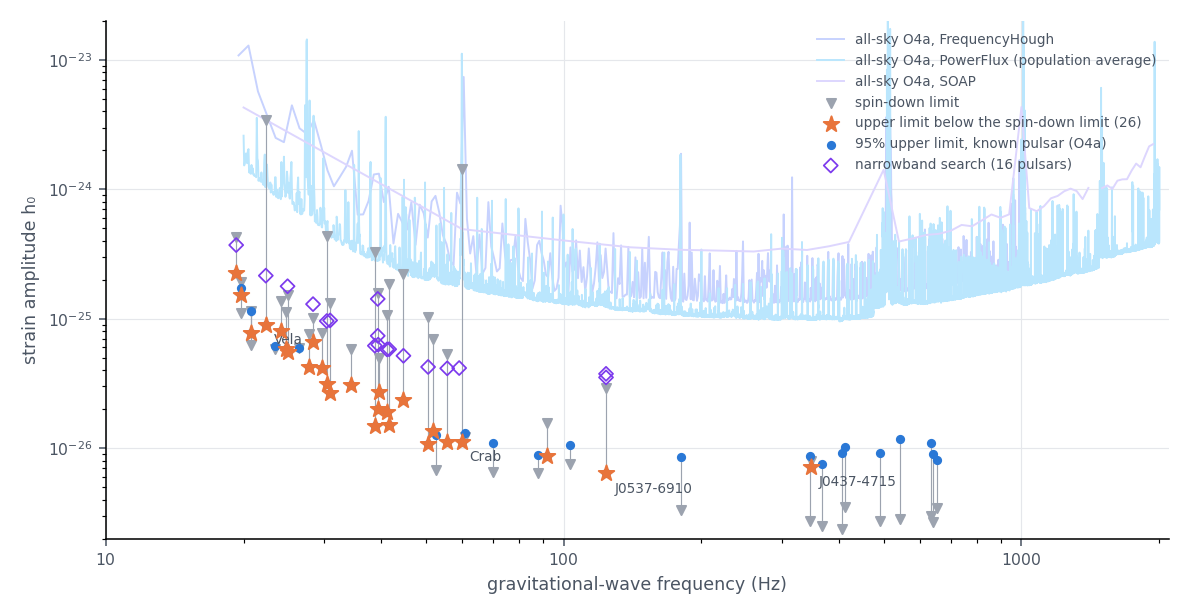
Each known pulsar's 95% upper limit (blue) against its spin-down limit (grey triangle: the strain if all the rotational energy it loses went into gravitational waves); the stars beat it, the Crab by a factor of 130. The open diamonds are the narrowband search, less sensitive than the targeted one but robust to a mismatch between the GW and the radio or X-ray timing (the Crab at 3% of its spin-down limit, about 0.1% of the spin-down energy in gravitational waves; the later O4 narrowband search of 34 pulsars brings it to 2%, ApJ 1005, 221 (2026)). The curves are the all-sky O4a sensitivity to unknown neutron stars, which must search every direction and spin-down.
Boson clouds and GW190728
A boson of mass \(m\) grows a cloud by superradiance around a black hole whose size matches its Compton wavelength, \(\alpha = G M m / (\hbar c) \sim 0.1\), and the cloud then annihilates into a continuous wave at
The scalar cloud fitted to GW190728 (scalar_cloud) has \(m_\phi = 0.89\) (0.70–1.17) × 10⁻¹² eV with the superradiance prior (0.73 (0.56–1.14) × 10⁻¹² eV agnostic), so the same particle would make clouds around Galactic black holes radiate at 340–570 Hz, inside the band of the O3 boson-cloud search, whose h₀ upper limits there are 1.2–1.9 × 10⁻²⁵.
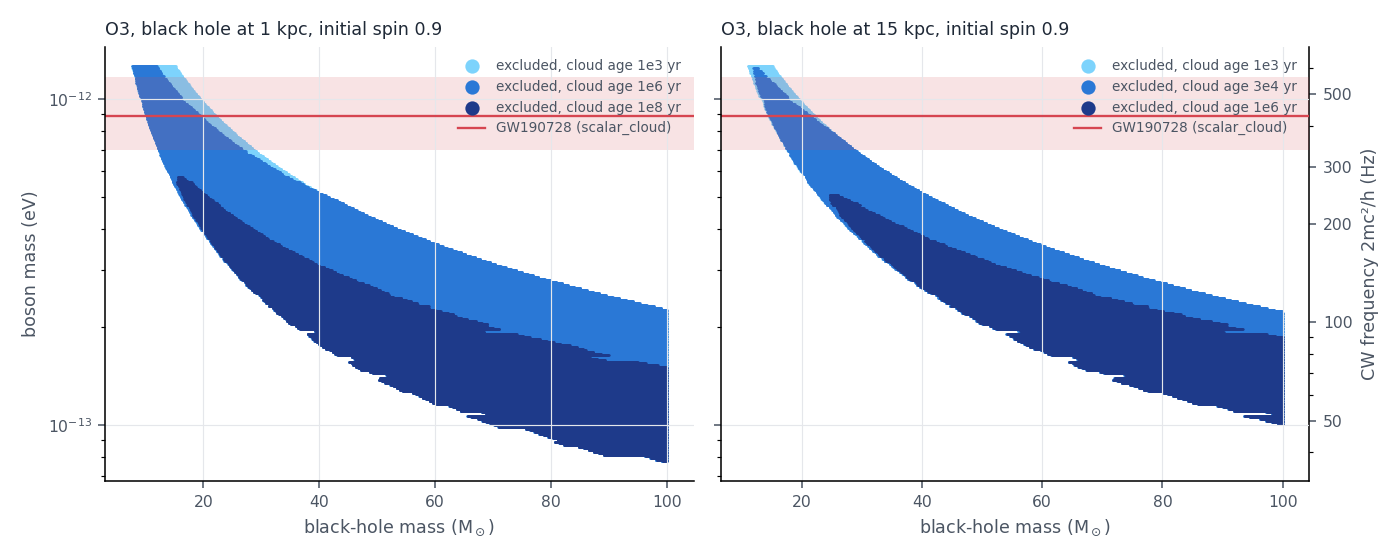
O3 exclusions for a black hole of initial spin 0.9 at 1 and 15 kpc, for clouds of different ages, with the GW190728 band. At these boson masses only light black holes are concerned, 8–28 M☉ at 1 kpc and 12–28 M☉ at 15 kpc for a young cloud: heavier ones are not superradiant for so heavy a boson. That is the mass range of GW190728's own components (12 and 8 M☉).
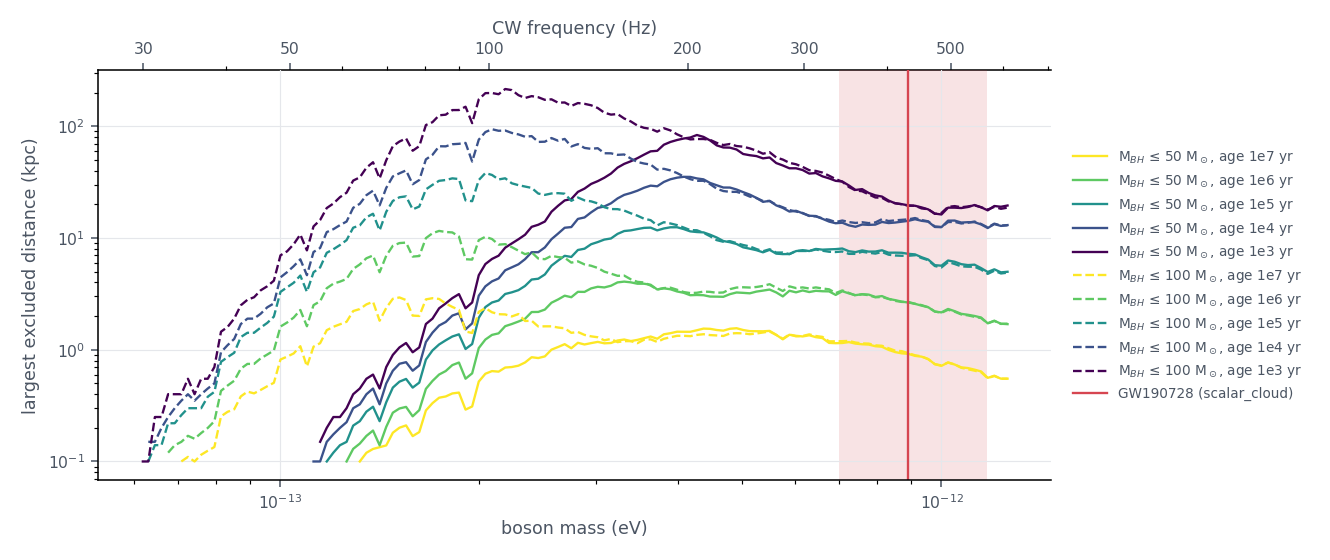
In the GW190728 band, clouds younger than 10³ yr are excluded out to 16–32 kpc, 10⁴ yr 13–15 kpc, 10⁵ yr 5–8 kpc, 10⁶ yr 2–3 kpc, 10⁷ yr about 1 kpc, for black holes up to 50 or 100 M☉.
What it means. The continuous-wave limits do not exclude the GW190728 boson: they say that no young cloud around a light, fast-spinning black hole sits within a few kpc of the Earth. A boson of that mass is compatible with them as long as such systems are rare or old; turning the limits into a constraint on the boson needs a model of the Galactic black holes (their number, masses, spins and ages). This holds for the continuous-wave limits only: the spins of black holes constrain the same boson more directly, and the scalar_cloud paper itself finds its main tension there, with GW190517, whose spin disfavours boson masses below about 1.1 × 10⁻¹² eV, most of the GW190728 band (scalar_cloud). The two probes are complementary: the merger tests a cloud carried by a binary, the continuous wave a cloud around an isolated black hole. Isolated Galactic black holes found by microlensing (one so far, many more expected with Rubin) come with a mass and a distance, the inputs of a directed search for their clouds.
Outputs
--out-report(HTML): the summary, the known pulsars, the all-sky limits and the boson clouds, with the plots;--out-summary(TSV): the summary;<name>.pulsars.tsv,<name>.narrowband.tsvand<name>.boson_reach.tsv: the pulsar upper limits, the narrowband limits and the distance reach for boson clouds;--plots-dir:cw_known_pulsars.png,cw_boson_exclusion.png,cw_boson_distance.png.
Options
| Option | Default | Meaning |
|---|---|---|
--boson-mass LOW MID HIGH |
GW190728, superradiance prior: 0.70e-12 0.89e-12 1.17e-12 | the band drawn on the boson plots, eV |
--boson-label |
GW190728 (scalar_cloud), or given band with --boson-mass |
its label |
--refresh |
off | download the data releases again (they are cached in ~/.cache_gwtc_analysis/continuous_waves, or $GWTC_CW_CACHE) |
--out-report, --out-summary, --plots-dir |
continuous_waves.html, continuous_waves.tsv, continuous_waves_plots |
outputs; the summary has three companions, <name>.pulsars.tsv (the 45 pulsars), <name>.narrowband.tsv and <name>.boson_reach.tsv (the largest excluded distance in the band) |
--data-repo {zenodo,s3,galaxy} |
zenodo |
where the LVK upper-limit files are downloaded from: their public sources, or a mirror holding the same files, s3 (the MinIO bucket, faster) or galaxy (the public usegalaxy.org history), else the public source (S3 mirror of the public files) |