counterpart
Where an electromagnetic counterpart and its host sit in the GW posterior of an event: on the sky, along the
line of sight, and against the orientation of the binary. It takes seconds. The Hubble constant of the event is
hubble_constant --method bright; this mode is about the association and the
quantities the H₀ depends on.
gwtc_analysis counterpart                                   # GW170817 and AT2017gfo
gwtc_analysis counterpart --viewing-angle 20 3              # with the viewing angle of the radio jet
gwtc_analysis counterpart --event GW190521                  # candidate flare ZTF19abanrhr
gwtc_analysis counterpart --event GW190521 --ra 190 --dec 30   # another position, same host redshift
Two notions used by the options
The list of known counterparts
gwtc_analysis has a small built-in list of events with an electromagnetic counterpart (in the code, the
COUNTERPARTS dictionary of gwtc_analysis/counterpart.py). --event picks one of them, and the list supplies
everything about the counterpart that the GW data do not give, so that no option is needed for it:
| Event | Counterpart (transient) and its position | Host galaxy and its redshift | PE file read | PE labels used by default |
|---|---|---|---|---|
| GW170817 | AT2017gfo, the kilonova: RA 197.4504°, Dec −23.3815° | NGC 4993: recession velocity 3327 ± 72 km/s, peculiar velocity 310 ± 150 km/s, so a Hubble-flow velocity of 3017 ± 166 km/s (z ≈ 0.0101) | the GWTC-1 samples, rebuilt by build_unofficial_pe | both: LowSpin, then HighSpin |
| GW190521 | ZTF19abanrhr, a flare in an active galactic nucleus (candidate): RA 192.4263°, Dec +34.8247° | AGN J124942.3+344929: z = 0.438 ± 0.0015 | the GWTC-2.1 file of GW190521_030229, from Zenodo | C01:IMRPhenomXPHM |
The same list serves hubble_constant --method bright. In the
options below, "from the list" means the value of this table. --ra/--dec, --redshift, --v-recession and
--v-peculiar override it for one run. Any other event of the GWTC PE releases (full name, e.g. GW190425_081805)
is analysed by giving its counterpart: --ra, --dec and --redshift (and --host, --counterpart-class); its
observing run comes from its name, its PE file from Zenodo. A permanent entry of COUNTERPARTS remains the way
to fix a published result.
PE labels
The PE file of an event does not hold one posterior but several: the LVK analysed each event with several waveform models and priors, and each analysis is stored under a label (see Waveform models). The labels of the two events:
| Event | Labels in its PE file | Difference |
|---|---|---|
| GW170817 | C02:IMRPhenomPv2_NRTidal-LowSpin, C02:IMRPhenomPv2_NRTidal-HighSpin |
the same waveform model with two spin priors: dimensionless spins up to 0.05 (as observed in Galactic neutron stars) or up to 0.89 |
| GW190521 | C01:IMRPhenomXPHM, C01:SEOBNRv4PHM, C01:Mixed |
two waveform models, and their samples mixed |
Each label gives its own sky position, distance and inclination, so the results differ slightly from one label to
the other. counterpart analyses every label it is given and writes one row per label in the summary; the
plots and the viewing-angle paragraph use the first label. --pe-label chooses the labels and their order:
gwtc_analysis counterpart --pe-label C02:IMRPhenomPv2_NRTidal-HighSpin   # the high-spin analysis only
gwtc_analysis counterpart --event GW190521 --pe-label C01:SEOBNRv4PHM    # another waveform model
Without --pe-label, the labels of the list above are used; for an event without default labels, all the labels
of the file, the low-spin ones first. For GW190521 the default is IMRPhenomXPHM because it is the only model with
enough samples near the flare.
Method
The mode runs no parameter estimation: it reads the released PE samples (and the LVK sky map) of the event and places the counterpart in them, with numpy, ligo.skymap for the sky map and its own flat ΛCDM distances. The quantities are listed in What it computes; this section says how the code gets them.
Inputs
- PE samples: the event's release file (the latest Zenodo version in the PE index, from Zenodo or the mirror
of
--data-repo, kept in the PE cache ofhubble_constant), or for GW170817 the bundle of build_unofficial_pe. Of each label, the columnsluminosity_distance,ra,dec,theta_jn(elseiota),mass_1,mass_2. - Sky map:
--sky-map, else the FITS map of the event for the label, from the Zenodo sky-map archive of its catalog, looked up only for a release file (not with--pe-file, nor for the GW170817 bundle). - Host redshift: from the list or the options.
What the mode does
- Host redshift. With velocities, \(v_H = v_r - v_p\), \(\sigma_v = \sqrt{\sigma_r^2 + \sigma_p^2}\) and \(z = v_H/c\). Its distance for each reference H₀ is \(d_L(z; H_0)\) in flat ΛCDM with Ω\(_m\) = 0.3065. The uncertainty σ\(_z\) is reported, but no quantity of this mode uses it.
- Fixed or free sky. If the median separation of the samples from the position is below 0.1°, the sky is fixed in the samples: no searched probability, all samples on the line of sight.
- Searched probability. From the map, ligo.skymap
crossmatch(...).searched_prob. Otherwise, a Fisher kernel on the sphere over at most 20,000 samples, its width the median angle to the \(n^{2/3}\)-th nearest neighbour (500 probe samples, at least 0.05°); the level is the fraction of samples (leave-one-out) where the density exceeds that at the position. - Line of sight. The samples within
--sky-radius; fewer than 200 skips the distance for that label. The distances are the posterior as released, PE prior included. Medians and 90% intervals are the 5, 50 and 95% quantiles; the "percentile" of a host distance is the fraction of samples below it. - Viewing angle \(\min(\theta_{JN}, 180° - \theta_{JN})\). The constraint weights each sample by \(\exp[-(\theta - \mu)^2/2\sigma^2]\); the effective number of samples is \((\sum w)^2/\sum w^2\).
- Implied H₀ of a sample at distance \(d\): the H₀ with \(d_L(z; H_0) = d\). The degeneracy table bins the viewing angle in 0–30°, 30–60° and 60–90°, unweighted.
The mode does not combine events and does not compute an H₀ posterior: that is
hubble_constant --method bright. Coincidences with GRB and neutrino catalogs are
searched by search_skymaps --counterparts, not here.
What it computes
For each PE label:
| Quantity | How |
|---|---|
| Searched probability of the counterpart's position | the credible level of the smallest sky region that contains it. From the LVK sky map of the event for this label (Zenodo archive of its catalog, ligo.skymap crossmatch); with --sky-map none, with --pe-file and no --sky-map, or when the event has no map (the GW170817 bundle), a kernel density estimate on the PE samples' sky positions; --pe-file with --sky-map FILE uses that map |
| Distance along its line of sight | the PE samples within --sky-radius of the position (all of them when the sky was fixed to the counterpart): median and 90% interval |
| Distance of the host redshift | \(d_L(z; H_0)\) for Planck (67.4) and SH0ES (73.0), with its percentile in the distance posterior: a host redshift far in the tails of the GW distance makes the association, or the cosmology, doubtful |
| Viewing angle | the angle between the line of sight and the total angular momentum, θ_JN folded to 0–90° (0° face-on) |
| Distance–inclination degeneracy | the distance samples against the viewing angle, each colored by the H₀ it implies at the host redshift, and a table by angle |
With --viewing-angle MEAN SIGMA |
an independent Gaussian constraint on the viewing angle (degrees), as weights on the samples: the distance and the angle with it, and the effective number of samples |
The searched probability from the samples converges slowly for a sky with fine structure: for GW190521 and ZTF19abanrhr, 0.55 from 20,000 samples and 0.62 from 50,000, against 0.64 from the LVK sky map. The map is used whenever the event's PE file comes from Zenodo.
GW170817 and AT2017gfo
The GWTC-1 samples have the sky fixed to AT2017gfo: there is no searched probability, and all the samples are on its line of sight.
| PE label | \(d_L\) (Mpc), 90% | Host at Planck H₀: 45.1 Mpc | Host at SH0ES H₀: 41.6 Mpc | Viewing angle, 90% |
|---|---|---|---|---|
| LowSpin | 40.0 (24.9–47.3) | percentile 82 | percentile 60 | 33° (9–62°) |
| HighSpin | 41.7 (29.1–47.5) | percentile 79 | percentile 49 | 28° (8–55°) |
| LowSpin, viewing angle 20 ± 3° | 44.5 (41.9–47.3) | 20° (15–25°) |
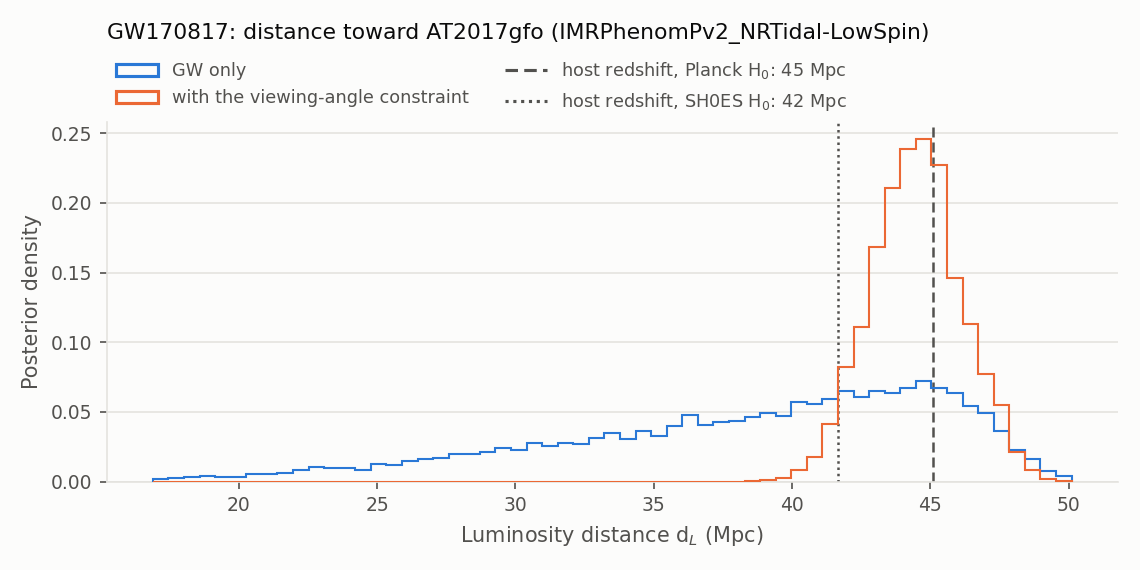
The host redshift is well inside the GW distance posterior for both values of H₀. The viewing-angle constraint (the radio jet, 14–26° at 41 Mpc, Hotokezaka et al. 2019 [73], here 20 ± 3°) keeps 1,600 effective samples of 8,078 and removes the low-distance tail.
The distance–inclination degeneracy
| Viewing angle | Samples | \(d_L\) median | H₀ implied |
|---|---|---|---|
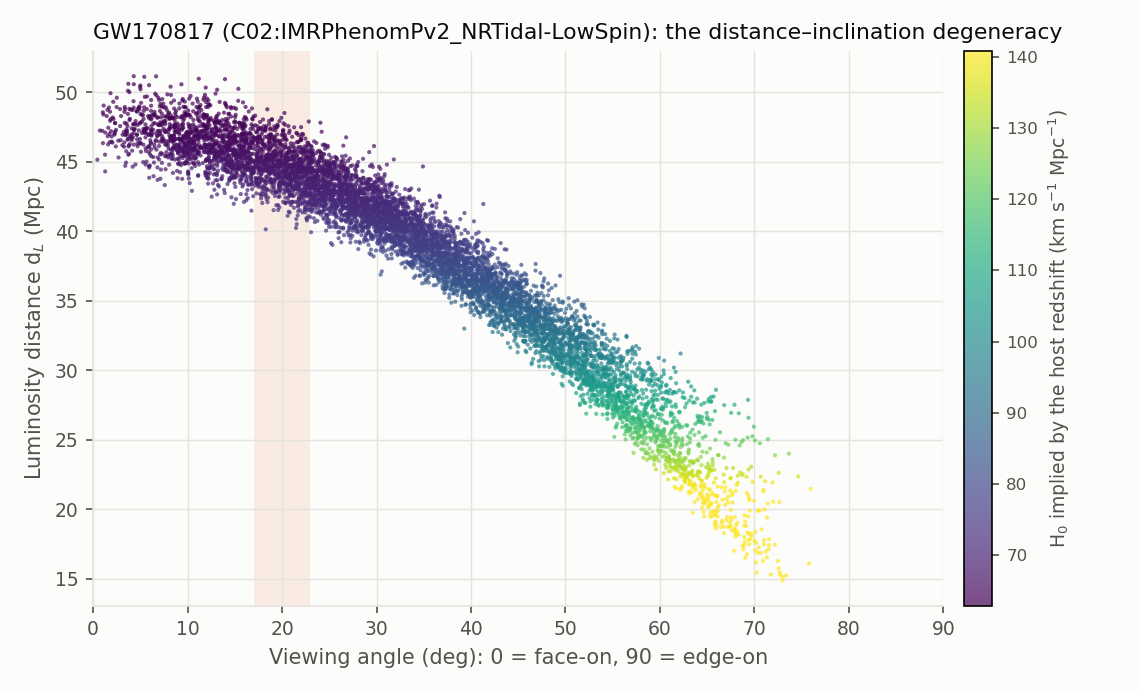
| 0–30° | 43% | 44.6 Mpc | 68 |
| 30–60° | 51% | 35.9 Mpc | 85 |
| 60–90° | 6% | 23 Mpc | 132 |
The samples form one band: the distance falls as the orbit is seen more inclined, because an inclined binary is fainter than a face-on one at the same distance. The inclination is measured, from all three detectors (θ_JN = 147°, 90%: 118–171°), but broadly: Virgo's response to GW170817 was small (the wave came close to one of its blind directions), which constrained the sky position but carried little polarization information, and near face-on the two polarizations are almost equal, (1 + cos²ι)/2 against cos ι. The upper tail of the bright-siren H₀ comes from the inclined orbits; the shaded band is the jet constraint, which removes them.
GW190521 and ZTF19abanrhr
| Quantity | Value |
|---|---|
| Searched probability of ZTF19abanrhr (LVK sky map, IMRPhenomXPHM) | 0.64 |
| Samples within 3° of the flare | 3,436 of 148,527 |
| \(d_L\) along that line of sight | 4.64 Gpc (90%: 1.75–7.12) |
| Host at z = 0.438: Planck H₀, SH0ES H₀ | 2.51 Gpc (percentile 21), 2.31 Gpc (percentile 18) |
| Viewing angle | 36° (90%: 10–84°) |
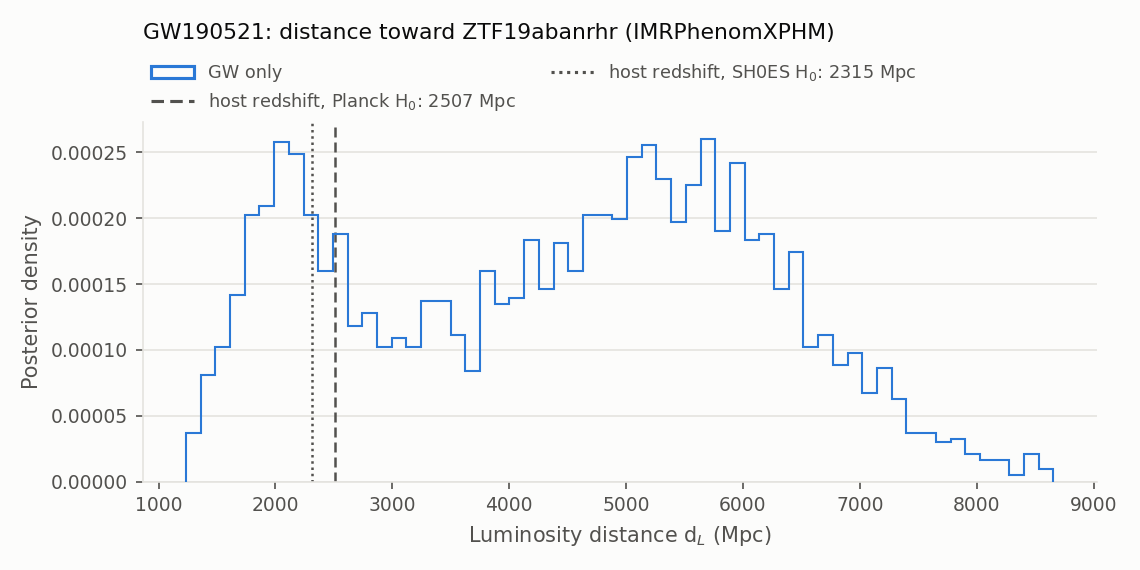
The flare is inside the 64% credible region of the sky, and the distance of its host for the usual values of H₀ falls on the lower of the two modes of the GW distance in that direction. Neither confirms nor excludes the association, with odds between 1 and 12 in its favour depending on the waveform model (Ashton et al. 2021 [75]); the bimodal distance is why the bright-siren H₀ of GW190521 is bimodal.
Outputs
- The HTML report ends with the PE files of this run: for each event the file read, its type (
nocosmo,cosmo,combinedor the GW170817 bundle) and where it was taken from (Zenodo, the S3 mirror, Galaxy, a PE cache), then the options of the run; see Which PE file is read; --out-report(HTML): the counterpart and host, the caveat of a candidate, the searched probability, the distance along the line of sight against the host redshift, the degeneracy and the constraint;--out-summary(TSV): one row per PE label with all the quantities above;--plots-dir:distance_<event>.pnganddistance_inclination_<event>.png.
Options
| Option | Default | What it is for |
|---|---|---|
--event |
GW170817 |
an event of the list of known counterparts (GW170817, GW190521), which sets the counterpart's position, the host redshift and the PE file; or any event of the GWTC PE releases (full name) with --ra, --dec and --redshift |
--ra, --dec |
the position from the list | the counterpart's position (degrees), required for an event outside the list; for a listed event, another position to test, for instance another candidate transient (the host redshift stays that of the list unless --redshift is given too) |
--host, --counterpart-class |
from the list | name of the host galaxy; BNS or BBH (for an event outside the list, from the catalog masses) |
--pe-label |
the labels from the list, else all the labels of the file | which analyses of the PE file to use, and in which order (PE labels); one row per label, plots from the first |
--pe-file |
the event's file (see the list) | read another PE file (PESummary layout, e.g. a newer release or your own run) instead |
--cache-dir |
.cache_gwosc |
where the rebuilt GW170817 file is kept (as in build_unofficial_pe) |
--pe-cache |
that of hubble_constant |
where the PE files downloaded from Zenodo are kept (GW190521) |
--redshift Z SIGMA |
from the list (GW190521) | the Hubble-flow redshift of the host and its uncertainty |
--v-recession V SIGMA, --v-peculiar V SIGMA |
from the list (GW170817) | for a nearby host, the redshift as velocities (km/s): measured recession velocity, and the peculiar velocity to subtract from it |
--sky-radius |
3° | when the PE samples are spread over the sky: the samples kept as "along the line of sight", those within this angle of the position. Not used for GW170817, whose samples are all at AT2017gfo |
--sky-map |
the event's LVK sky map | FITS sky map for the searched probability; none computes it from the PE samples instead |
--viewing-angle MEAN SIGMA |
none | an independent measurement of the viewing angle (degrees, Gaussian), e.g. from the radio jet of GW170817, to see how it narrows the distance |
--pe-distance-prior |
— | refused here: the distances reported are the PE posterior as released (the option is shared with the bright siren, which divides the prior out) |
--out-report, --out-summary, --plots-dir |
counterpart.html, counterpart.tsv, counterpart_plots |
the HTML report, the summary table (one row per PE label) and the plots |
--data-repo {zenodo,s3,galaxy} |
zenodo |
where the PE file are downloaded from: their public sources, or a mirror holding the same files, s3 (the MinIO bucket, faster) or galaxy (the public usegalaxy.org history), else the public source (S3 mirror of the public files) |