primordial_black_holes
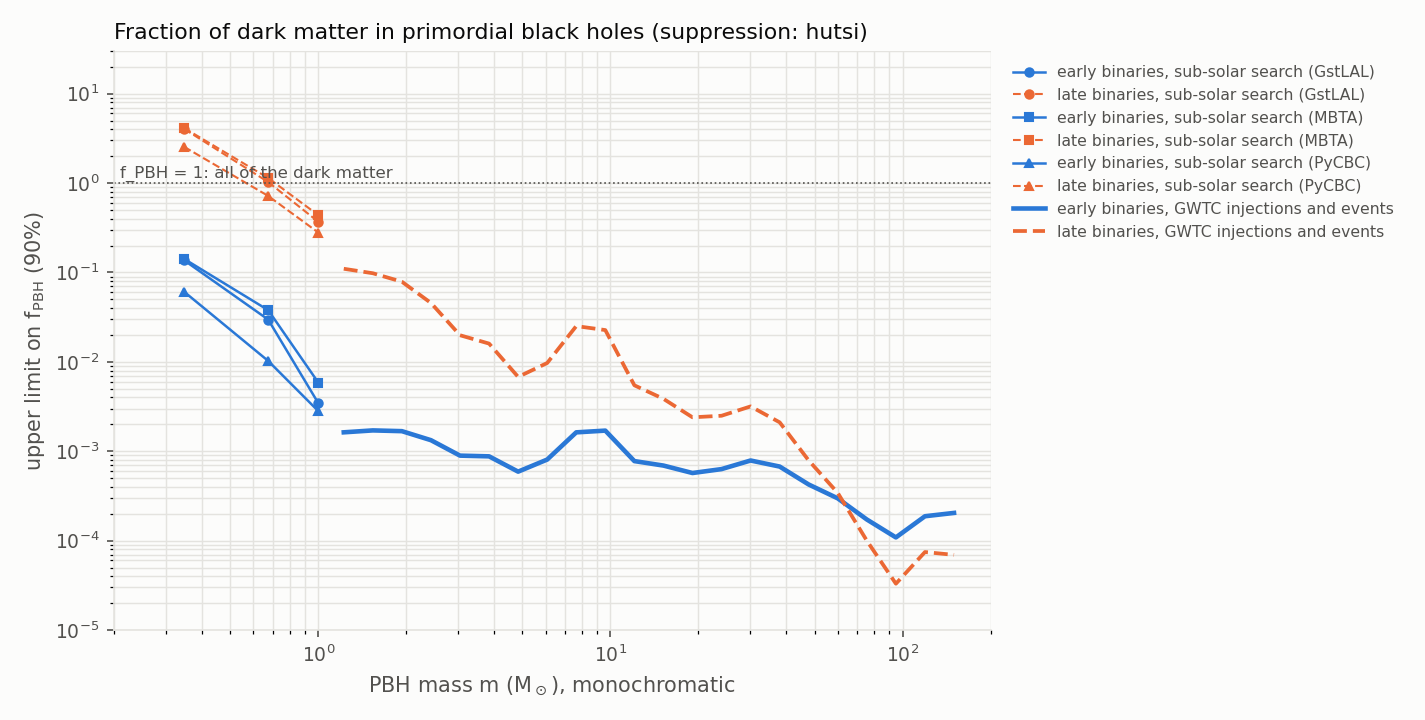
Upper limits on f_PBH, the fraction of the dark matter in primordial black holes of a single mass, from the merger rates: a PBH population merges at a rate that grows with f_PBH, and that rate may not exceed what the data allow. The physics is explained in Primordial black holes and sub-solar masses.
gwtc_analysis primordial_black_holes                       # 0.35-150 Msun, the default choices
gwtc_analysis primordial_black_holes --suppression lvk     # the suppression fit of the LVK sub-solar papers
gwtc_analysis primordial_black_holes --attribute none      # the observed events taken as astrophysical
Method
Merger rates of a PBH population
For PBHs of mass m, a fraction f of the dark matter, the mode uses two formation channels.
Early binaries, formed in the radiation era and merging today (Raidal et al. 2019 [123]; Hütsi et al. 2021 [124], eq. 2.1), with M = 2m and η = 1/4:
S < 1 is the suppression: binaries disrupted by other PBHs (S₁, through the number N̄ of PBHs around the pair)
or by later encounters (S₂). Two choices, --suppression:
--suppression |
S | Where it holds |
|---|---|---|
hutsi (default) |
S₁ S₂ of [124]: eqs. 2.2, 2.3, A.5 for S₁ (monochromatic: ⟨m²⟩/⟨m⟩² = 1, N̄ = 2f / (f + σ_M), σ_M = 0.004) and the z = 0 fit 2.7 for S₂ | every f |
lvk |
2.3 × 10⁻³ f^−0.65, the fit of the LVK sub-solar papers [101], [122] | equal to S₁ S₂ at f = 1; 1.3 times smaller at f = 0.1, 2.9 times at f = 0.01; above 1, which is unphysical, below f ≈ 10⁻⁴ |
The two give the same limits near f = 1 and differ by up to ~6 at f ~ 0.01: the LVK numbers for the sub-solar
searches are reproduced with lvk, while the catalog limits, at f ~ 10⁻⁵–10⁻³, need hutsi.
Late binaries, formed by capture in PBH clusters (Phukon et al. 2021 [125], eq. 2; Clesse & García-Bellido [126]): R_late = f × 420 Gpc⁻³ yr⁻¹ (2m)^(10/7) / (m²)^(5/7), linear in f and taken constant in time.
The limit on f is where the PBH rate equals the rate limit R₉₀ (solved in closed form for lvk and for the late
binaries, numerically for hutsi). Values above 1 mean no constraint.
Rate limits from the data
| Masses | Data | Rate limit |
|---|---|---|
| 0.35–1 M☉ | the sensitive volume-time of the LVK sub-solar-mass searches, O4a + O4b combined, per pipeline (GstLAL, MBTA, PyCBC) and chirp-mass bin (results-PBH.zip of Zenodo 23346454, [122]); m = 2^(1/5) × the bin's chirp mass |
no significant candidate: R₉₀ = −ln(1 − 0.9) / VT = 2.30 / VT, as in the LVK papers |
| above 1 M☉ | the search-sensitivity injections of rates (--sensitivity-release), reweighted to binaries with both masses log-uniform in [m e^−w, m e^w] (w = --mass-window); the GWOSC events with FAR ≤ --far-threshold whose median chirp mass lies in 2^(−1/5) [m e^−w, m e^w] |
the 90% Poisson upper limit for n events, Γ⁻¹(0.9; n + 1) / VT (2.30 / VT for none) |
- Only the sub-solar bins up to 1 M☉ are used, as in the LVK papers: the searches require a secondary below 1 M☉, so their higher chirp-mass bins hold unequal binaries, not the equal-mass binaries of a single PBH mass.
- Events are matched by chirp mass, the best-measured mass. The mass ratio is poorly measured and its median is pulled away from 1 by the priors, so a window on both component masses would miss equal-mass sources and give limits too tight by up to ~10. An unequal binary with the right chirp mass also counts, which is conservative for an upper limit.
--attribute window(default) lets every such event be primordial;--attribute nonetakes n = 0, i.e. all the observed events are astrophysical: a tighter limit (early binaries down to 8.3 × 10⁻⁵ at 50 M☉ with the default injections, late binaries ~3 × 10⁻⁵) and a much stronger assumption.- The early-binary volume includes the rate evolution (t/t₀)^(−34/37) (Planck15), so that VT × R(z = 0) is the
expected number of detections; spins as in
rates(|a| < 0.4 below 2.5 M☉, else 0.99).
Results
With the defaults (gwtc5 injections, 259 events with FAR ≤ 1/yr):
| PBH mass | Early binaries, hutsi |
Early binaries, lvk |
Published |
|---|---|---|---|
| 0.35 M☉ (sub-solar) | 0.061–0.142 | 0.096–0.178 | 0.10–0.18 [122] (LVK fit) |
| 1 M☉ (sub-solar) | 0.0028–0.0059 | 0.018–0.032 | 0.018–0.032 [122] (LVK fit) |
| 1.2–2.5 M☉ (catalog) | 0.0013–0.0017 | 0.004–0.007 | ~2 × 10⁻³ at 1.5 M☉ [102] (astrophysics only) |
| 12–38 M☉ (catalog) | 0.0006–0.0008 | 0.0007–0.0015 | ~1.5–2 × 10⁻⁴ [102] (astrophysics only) |
| ~100 M☉ (catalog) | 1.1 × 10⁻⁴ | (S > 1: not valid) | ~1 × 10⁻⁴ at 50–90 M☉ [102] (astrophysics only) |
Ranges over the three pipelines for the sub-solar searches. Two checks:
- The LVK sub-solar limits are reproduced exactly with their suppression fit (
--suppression lvk): 0.0183–0.0324 at 1 M☉, 0.0958–0.178 at 0.35 M☉; late binaries cross f = 1 at 0.62–0.74 M☉ (linear interpolation between the bins, as in the LVK script), the paper's 0.62–0.74 M☉. - The two data sets agree where they meet: at 1–2.6 M☉ the sub-solar VT (unequal binaries, not used above 1 M☉) and the GWTC injections give the same early-binary limit, 0.0013–0.0028.
Late binaries give weaker limits below ~50 M☉ and tighter ones above: for equal masses their rate, 420 × 2^(10/7) f ≈ 1130 f Gpc⁻³ yr⁻¹, does not depend on m, while the early-binary rate falls as M^(−32/37).
Relation to Andrés-Carcasona et al.
The catalog limits of [102] (O1–O4a, 161 events with FAR < 1/yr) use the same
early-binary rate and the same suppression: their eq. A.1 is eq. 2.1 of Hütsi et al.
[124], with the suppression "from the analytical prescriptions" of that paper, i.e.
--suppression hutsi. The rest differs:
| [102] | primordial_black_holes |
|
|---|---|---|
| PBH channels | early two-body + early three-body (γ = 1, K = 4) | early two-body; late binaries in clusters |
| Mass function | monochromatic and log-normal | monochromatic |
| Detection probability | semi-analytic, single-detector SNR > 8 with representative noise spectra | the LVK search-sensitivity injections, FAR ≤ 1/yr (as in rates) |
| Statistics | hierarchical Bayesian likelihood (dynesty, bilby) | Poisson upper limit in a chirp-mass window |
They treat the observed events in three ways:
- Astrophysics only: all events are astrophysical; the 95 % bound is where the expected number of PBH detections
N < 3. These are the solid curves of their Fig. 1 and the [102] values in the tables (~10⁻² at 0.5 M☉, ~2 × 10⁻³
at 1 M☉, ~2 × 10⁻⁴ at 10 M☉, ~1 × 10⁻⁴ at 50–90 M☉; their text's "between 10⁻² and 10⁻⁴" spans 0.5–90 M☉). Counterpart here:
--attribute none(2.30 / VT, 90 %). - Agnostic: any subset of events may be primordial (10⁵ random subsets, or a subset-marginalised likelihood);
slightly weaker at 2–20 M☉. Rough counterpart:
--attribute window(every event in the window may be primordial). - Astrophysically informed: a joint fit of a power law + 2 peaks (Multi Peak) astrophysical population and a log-normal PBH population. No counterpart.
Why the mode does not reproduce their analysis. It extends the method of the LVK sub-solar searches, a rate
limit from the published search sensitivity, which it reproduces exactly below 1 M☉, to the catalog masses with the
same LVK injections as rates: one framework from 0.35 to 150 M☉, from public data, in minutes. Their case 1 is a
comparable computation (and the three-body channel or a log-normal mass function could be added at little cost);
cases 2 and 3 need the posterior samples of all events and nested sampling over ~16 population parameters, or 10⁵
subsets, hours to days of computing.
Comparison with their case 1. --attribute none with --sensitivity-release gwtc4 (O3 + O4a, their data
period) against the monochromatic constraint of their Fig. 1 (read from the figure, ±20–30 %):
| PBH mass | this mode, none, gwtc4 (90 %) |
[102], astrophysics only (95 %) |
|---|---|---|
| 1.5 M☉ | 1.8 × 10⁻³ | ~1.8 × 10⁻³ |
| 3 M☉ | 9.1 × 10⁻⁴ | ~8 × 10⁻⁴ |
| 10 M☉ | 3.2 × 10⁻⁴ | ~2.3 × 10⁻⁴ |
| 20 M☉ | 1.8 × 10⁻⁴ | ~1.5 × 10⁻⁴ |
| 30 M☉ | 1.3 × 10⁻⁴ | ~1.2 × 10⁻⁴ |
| 50 M☉ | 1.1 × 10⁻⁴ | ~1.0 × 10⁻⁴ |
| 90 M☉ | 1.4 × 10⁻⁴ | ~1.1 × 10⁻⁴ |
| 120 M☉ | 2.0 × 10⁻⁴ | ~1.5 × 10⁻⁴ |
Agreement within a factor 1.0–1.4, despite the different detection probability (injections against SNR > 8), the
missing three-body channel and 90 % against 95 %. The ~10⁻⁵ level of their Fig. 1 is the dashed "sensitivity floor"
(expected detections N > 0.05), not a constraint. The default --attribute window is 2–4 times weaker at
10–50 M☉, where events fall in the window, as their agnostic case is weaker than their case 1.
Limitations
- Not the analysis of Andrés-Carcasona et al. [102]; see the section below. Monochromatic mass function only, no three-body channel, and the catalog part is a Poisson count in a mass window, not a hierarchical fit.
- No search: the mode uses the published search sensitivities and the catalog; a sub-solar candidate below the catalog threshold, or an alert (HasSSM), does not enter.
- A sub-solar merger need not be primordial: collapsar disks may fragment into sub-solar neutron stars that merge (Metzger et al. 2024 [103]); unlike PBHs, that channel shines.
- The S₂ fit of [124] is for z = 0; its redshift dependence is not included.
Options
| Option | Default | What it provides | When to change it |
|---|---|---|---|
| Masses | |||
--masses |
22 values from e^w to 150 M☉ | the PBH masses of the catalog part; each must satisfy m e^−w ≥ 1 M☉, where the injections start | a finer grid, or a few masses of interest |
--mass-window |
0.2 | w, the half-width of the window in ln m: binaries in [m e^−w, m e^w] for the VT, chirp masses in 2^(−1/5) [m e^−w, m e^w] for the events | smaller for a sharper mass function (fewer injections: the effective sample size is in the TSV) |
--no-sub-solar |
off | leave out the sub-solar searches (0.35–1 M☉) | to skip the download of the sub-solar release |
| Physics choices | |||
--suppression |
hutsi |
the suppression of the early-binary rate: S₁ S₂ of Hütsi et al. 2021, or the LVK fit 2.3 × 10⁻³ f^−0.65 | lvk to reproduce the LVK sub-solar papers |
--attribute |
window |
which observed events may be primordial: those with their chirp mass in the window, or none | none for the limit if all the events are astrophysical |
| Data | |||
--far-threshold |
1 | FAR threshold [1/yr] for the found injections and the events | as in rates |
--sensitivity-release |
gwtc5 |
the LVK search-sensitivity injections of the catalog part, as in rates |
gwtc4 for O3 + O4a only |
--sensitivity-file |
— | a local injection file instead of the release | offline runs |
--data-repo |
zenodo |
where the injections and the sub-solar release are downloaded from: zenodo, s3 (the MinIO mirror) or galaxy | s3 for faster downloads |
| Outputs | |||
--out-limits |
pbh_limits.tsv |
one row per mass (and pipeline): VT, effective sample size, events counted, R₉₀, the early- and late-binary limits | — |
--out-report |
pbh_limits.html |
the HTML report | — |
--plots-dir |
pbh_plots |
the plot of the limits against the mass | — |